
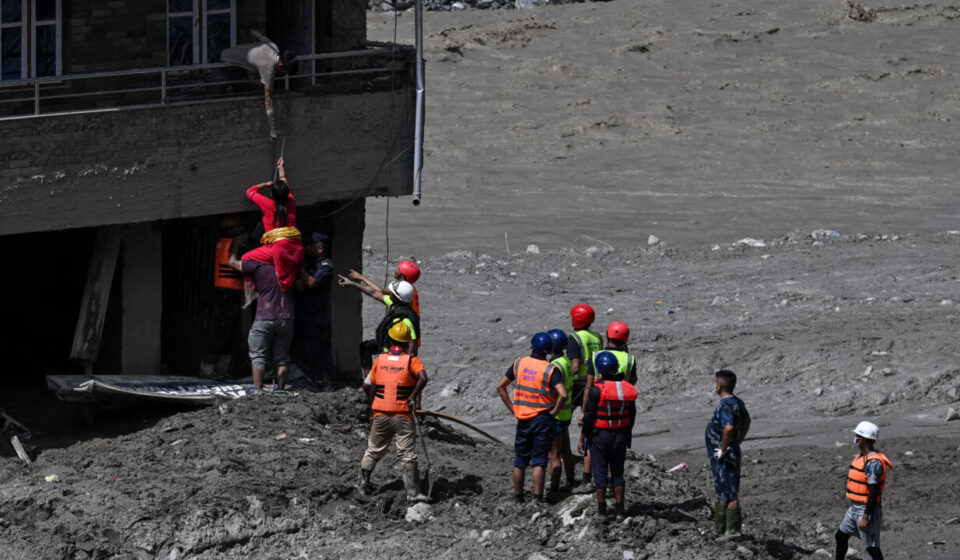

Rescue teams searching for survivors of a deadly flash near the border between Nepal and Tibet were forced to stop their work on Friday after water overran the banks of a lake formed by mountains of debris upstream of the flood zone.
While rescuers were later able to resume their search, the spectre of a fresh onslaught of water rolling over those who rushed to the remote Himalayan region to help in the wake of the catastrophe hammered home the vast challenges facing the rescue teams.
Police in Nepal on Friday said at least 552 people had been killed in the disaster. Chinese authorities on Friday raised the death toll in Tibet from three people to five. More than 1,400 people are still missing.
Nepalese and Chinese authorities have vowed to use all the means at their disposal to help those affected.
Nepal: A newly formed lake is sparking fears of more flooding along the Chinese border
One of your browser extensions seems to be blocking the video player from loading. To watch this content, you may need to disable it on this site.

‘Most difficult terrain in the world’
The overflowing “barrier lake” is one of two bodies of water formed by the torrents of mud and rubble carried away by the flood, according to an official with Nepal’s Disaster Management Authority. The official added that both lakes would continue to pose a flood risk until the water had fully drained – particularly in light of the torrential rains that are expected in coming days.
Simon Cook, a glaciologist at the University of Dundee, said the risk of further flooding looked all too real.
“This dam is just made of loose rock and mud and so on, it’s not a carefully engineered dam that you might have for a reservoir or a hydropower project – it’s just loose debris holding back presumably many million cubic metres of water,” he said. “And the worry is that as more water enters that lake, it either overpowers the dam because the dam is just not strong enough to hold it, or it overtops the dam and cuts a notch through the dam material. And then once it starts cutting into that dam, the whole thing could be released.”
Read more‘Ran for our lives’: Flood survivors recount terrifying escape from Nepal-Tibet disaster
For rescuers locked in a race against time to recover as many survivors as possible, the conditions are far from ideal.
“I would definitely classify this as one of the more complicated rescue missions there is,” said Daniel Nohrstedt, a specialist in crisis management following natural disasters at the University of Uppsala in Sweden.
Researchers said the region’s rugged terrain and the wet forecast are first and foremost among the steep obstacles that rescue crews must grapple with.
“We are dealing with just about the most difficult terrain in the world for this kind of rescue,» said David Alexander, a specialist in emergency response planning at University College, London.
The mountainous region was hard enough to access even before the disaster, but now the ways in and out of the area are almost impassable; Wednesday’s floods have swept away most of the bridges and clogged the roads with deep banks of mud.

Deploying excavators capable of clearing the widespread debris, for example, would run the risk of triggering further landslides, disaster management specialists said.
“Helicopter is probably the only way,” said Alexander. Nepal’s disaster management authority on Friday said that more than 3,000 people had been airlifted from the disaster zone by helicopter.
But going in by air is not easy either. The sheer amount of mud and water in the most seriously hit areas makes landing difficult, and the weather is hardly likely to make it any better.
The flash flood came at the height of the region’s monsoon season, which means that heavy rains could thunder down at any minute from a sky that rarely clears. Nohrstedt said that even airborne operations were dangerous under these conditions – not just for rescue crews trying to land in the worst-hit areas, but for survivors being evacuated by air.
“Even going in with a helicopter in this area, you run a big risk that the helicopter will go down,” he said. “Especially if the weather conditions are bad.”
Race against time
Alexander said that coordinating the rescue efforts could well be hampered by the imposing landscape.
«There also may be problems of communication by radio,” Alexander said. “It can be rather difficult in high mountain terrain where much of the signal is blocked.»
“Given the magnitude of this disaster, a third challenge would be to orchestrate all the different organisations involved – both government organisations and civil society organisations – or to coordinate the response effectively in a short period of time,” Nohrstedt said. “That’s always a challenge, because there’s no single organisation who has the full responsibility for a situation like this – the organisations will depend on each other to coordinate an effective response.”
Moving quickly is becoming all the more urgent as the forecast turns grim. Strong rains are expected in the days to come, which will inevitably make rescue operations even more difficult.
Nepal floods explained: The chain of events behind the disaster
One of your browser extensions seems to be blocking the video player from loading. To watch this content, you may need to disable it on this site.

These rains could potentially even unleash further floods as the precipitation swells the upstream barrier lakes. Satellite imagery Friday showed the larger of the two lakes appeared to be growing in size, with no visible outlet that would let the mounting pressure out.
Nohrstedt compared the situation to the aftermath of an earthquake, when rescuers have to be on guard for aftershocks.
Rescue teams are therefore caught in an almost impossible situation. The harsh terrain and mud-choked roads mean they cannot move quickly, for their own safety and the safety of the survivors yet to be found. But faced with the pounding monsoon rains and risk of further flooding, they also have little time to lose.
This article has been adapted from the original in French by Paul Millar.
Fuente:
Leer la noticia original