
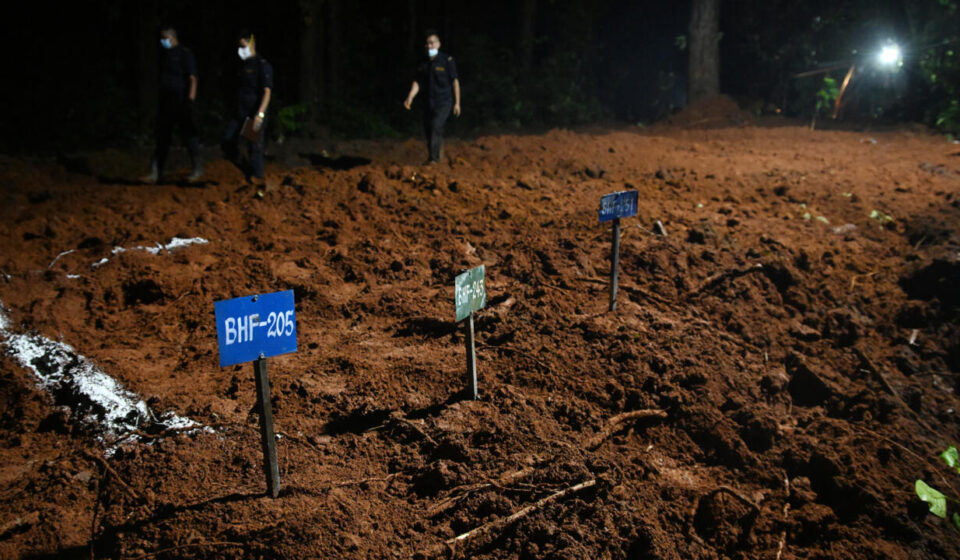

Nepal was burying on Monday some of the hundreds of bodies retrieved after a devastating tsunami-like flood crashed through the Himalayan region, sweeping away villages and leaving thousands still missing.
Distraught families have packed rescue stations and hospitals in search of their missing relatives, while others have faced the grim task of identifying bodies at overflowing morgues.
The huge wave of ice, rocks and debris that smashed into villages and towns on Wednesday claimed more than 900 lives in both Nepal and Tibet – across the border in China – with reports of some bodies possibly swept downstream as far as India.
Nepal’s disaster agency said Monday that 903 deaths had been counted there, with 4,247 people, including 592 foreigners, still missing. Some 933 workers at hydropower plants are among those unaccounted for in Nepal.
As of Sunday, Chinese authorities reported 16 deaths and 546 missing. Chinese state media said 261 of the missing were foreigners, including over a hundred Nepalis.
Read moreRescuers grapple with a mountain of challenges after the Nepal-Tibet floods
Nepali army troops and engineers drilled through debris on Sunday towards workers believed to be trapped in a tunnel at the Trishuli 3A hydroelectric site in the Himalayan river valley after they successfully inserted a pipe into the passage.
Workers who managed to get out described horrifying scenes when the disaster struck.
Surendra Dowluri, 33, from India’s Andhra Pradesh state, said raging water swamped the Upper Trishuli-1 site, where he was working.
«We heard a very loud sound… and saw that the turbine floor was submerged with slush, and six workers were stuck in that,» Dowluri told AFP in the Nepali capital Kathmandu after his rescue four days into the disaster.
«We managed to rescue five of them, but one person lost his life,» he said, describing how some workers reached higher ground or construction areas out of reach of the torrent.
In northern Nepal, people living ‘under constant fear’ amid fresh flooding fears
One of your browser extensions seems to be blocking the video player from loading. To watch this content, you may need to disable it on this site.

Overnight rain and rising river waters also hampered rescue operations on Sunday, filling the excavation area with water before conditions eased, the Nepali army said.
Brigadier General Raja Ram Basnet, Nepal’s army spokesman, said authorities had intensified their rescue efforts in the disaster zones.
“We are working in search and rescue of the stranded people from hills, settlements and river areas,” he said.
Read moreWeek in pictures: devastating floods in Nepal, death of Dolly Parton and a tornado in France
Wednesday’s flash floods started after a glacial collapse high in the Himalayan region. Scientists who studied satellite images said bedrock underneath a glacier high in the Himalayas had collapsed, taking part of the glacier with it. The rockfall was so extreme that it registered as a magnitude 5.2 seismic event.
The rocks and melted water then swelled the rivers in the valleys below, causing a torrent of water that swept buildings, bridges and earth downstream in Tibet and Nepal.
The deluge also caused the formation of huge lakes held back by mud and debris, closely watched by emergency workers for risks to their operations.
Overwhelmed by the number of bodies and without proper freezing facilities, Nepali authorities have had to begin burials before completing the identification process.
Officials said DNA samples were taken from the bodies so that families could later identify them and perform traditional funeral rites.
Grieving relatives gathered at identification centres to watch LED screens showing pictures of the retrieved bodies, occasionally closing their eyes when the grim exercise overwhelmed them.
Walking out from one such building next to a makeshift morgue, Shobha Adhikary told a local coordinator she believed one image showed her childhood best friend.
«It looks like him, for sure,» she said, showing coordinators a photograph of a smiling, middle-aged man.
(FRANCE 24 with AFP and AP)
Fuente:
Leer la noticia original