
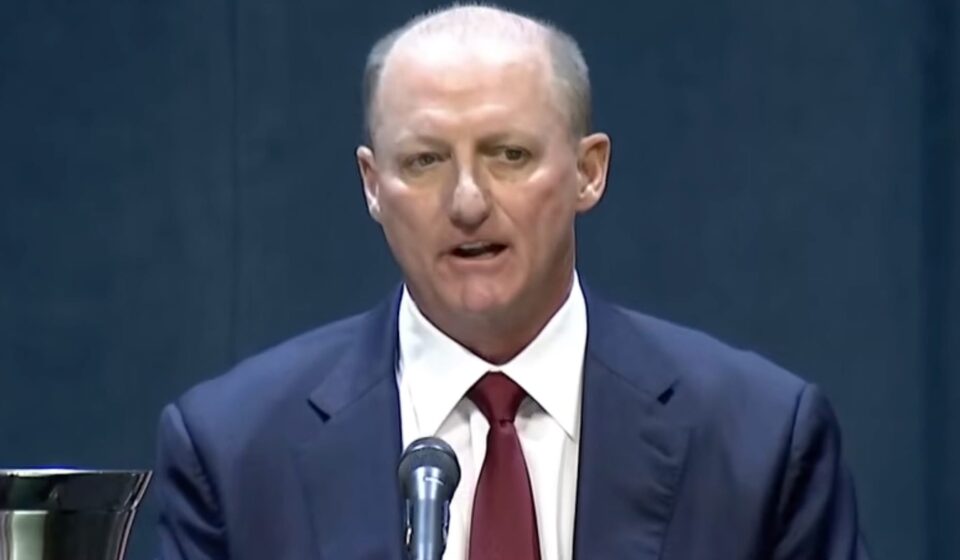

Greg Abel, CEO of Berkshire Hathaway, speaks during the Berkshire Hathaway Annual Shareholders Meeting in Omaha, NE on May 2, 2026.
CNBC
Berkshire Hathaway CEO Greg Abel discussed with CNBC’s Becky Quick on Wednesday the conglomerate’s massive investment in Google-parent Alphabet, calling the tech giant a «significant player» in artificial intelligence.
Abel said that Berkshire has clear view of the impacts that AI is having across its portfolio of companies, and that Google’s position relative to the emerging technology is strong.
«We have a lot of visibility from within our companies as to how we’re using AI, what type of benefits it’s delivering, so that brought incremental interest, and then we saw Google as a significant player,» he told Quick.
Berkshire took a $10 billion stake in Google 15 months ago at a 6.5% discount, Abel said.
«They hadn’t set the size, but recommended that we consider 10 billion. And Warren and I discussed the size. We discussed the size of discount, and I’d recommended six-and-a-half percent discount, and we were comfortable with that,» Abel said. «Then ultimately consummated the transaction.»
Berkshire added a total of $17 billion of Alphabet shares in the second quarter, making it the third largest holding in Berkshire Hathaway’s equity portfolio, according to the company’s Q2 portfolio snapshot filed with the SEC in August.

GOOGL year to date
As of the company’s last filing, Berkshire owns around 106 million of Alphabet’s Class A and Class C shares, currently worth around $36.6 billion. Alphabet purchases were the largest addition to Berkshire’s portfolio of the quarter, but Berkshire also bet big on Delta Air Lines, increasing that position by 44%, or roughly $1.6 billion.
Google is one of the five so-called hyperscalers executing huge capital expenditures to expand their computing power to run AI, along with Microsoft, Meta, Amazon and Oracle. Global hyperscaler capex for 2026 is estimated to be around $1 trillion, according to investment bank Goldman Sachs, but there is significant variance within estimates.
«Estimates indicate that the commonly cited forecast for hyperscaler capex of $794 billion likely understates the total amount of global AI capex by around $200 billion. At the same time, the $794 billion figure likely overstates the amount of US investment in AI by $200 billion,» Goldman Sachs researchers wrote in an August research analysis.
The question for investors is to what extent these huge investments will pay off and over what time frame.
AI computing workloads are generally split up into the two categories of algorithmic training based on large datasets and inference, or query response.
«A prolonged training-dominant phase extends the ROI timeline as CapEx and R&D continue to be deployed in advance of broad monetization,» Goldman Sachs researchers wrote in May.
Fuente:
Leer la noticia original