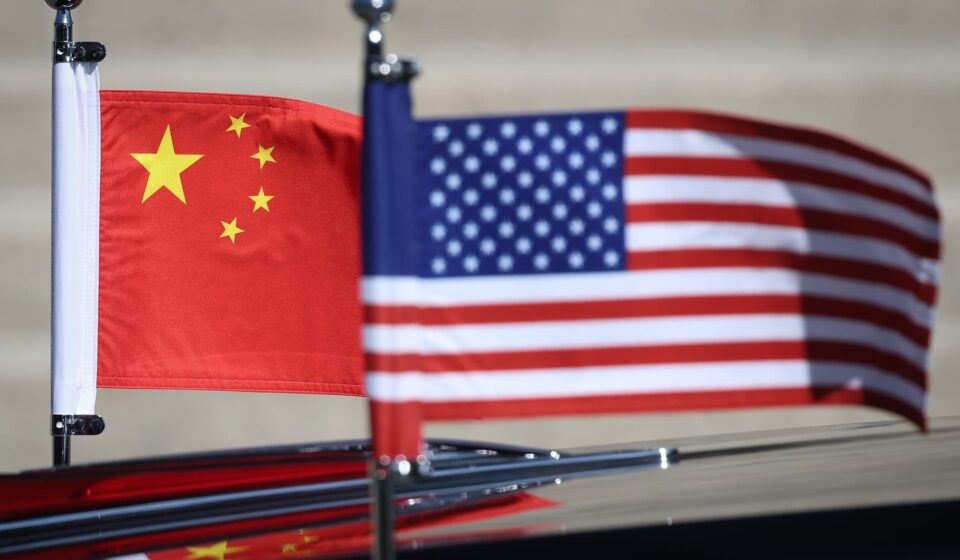

The American and Chinese flags are seen on the motorcade of U.S. President Donald Trump as he visits the National Archives Museum with President of China Xi Jinping on September 25, 2026 in Washington, DC.
Win Mcnamee | Getty Images
Hello, this is Anniek Bao writing to you from Singapore. Welcome to another edition of CNBC’s Daily Open.
The ink on the Trump-Xi trade truce extension is barely dry, and markets are busy turning the page to a potential U.S.-Iran deal that could end the Middle East war.
Treasury yields are at their highest since 2007, and as oil creeps higher on the Iran standoff, investors find themselves in yet another guessing game.
What you need to know today
Chinese President Xi Jinping‘s state visit to Washington appears to have produced more personal diplomacy than breakthroughs.
The U.S. and China agreed to reduce tariffs on $30 billion of goods and launched a dialogue on AI. The tariff reductions would apply to U.S. exports such as agricultural goods, wood and cosmetics, as well as U.S. imports including small appliances, toys and decorations, according to a White House statement.
That said, the agreement appears to stop short of any concrete purchase commitment, and the two-month trade truce extension appears to be somewhat constrained compared to analysts’ pre-summit expectations of at least six months.
«There wasn’t complete agreement on everything,» said Peter Alexander, Shanghai-based managing director at Z-Ben Advisors, describing the post-summit relations as «a fraught relationship where neither side is willing to give way, at least not at this juncture.»
On the Middle East conflict, Xi and U.S. President Donald Trump agreed that Iran should fulfil its commitment not to develop nuclear weapons, and that no country or entity should impose transit tolls on international waterways.
Iranian Foreign Minister Abbas Araghchi told NBC’s «Meet the Press» on Sunday that Tehran is ready for a «doomsday» war with the U.S. but is still pursuing diplomacy so as not to «miss any chance for peace.»
The remarks came days after Araghchi proposed reopening the Strait of Hormuz and resuming nuclear talks within seven days if Washington accepted Iran’s terms. The warring powers have been locked in an on-again, off-again war since late February — one that’s kept a lid on global oil supply and a foot on the gas pedal for inflation.
The standoff might have led to a near-incident on U.K. soil: British police arrested five men Sunday on suspicion of terrorism and explosives offenses near a U.K. air base used in U.S. strikes on Iran, after a tip that three vans had been spotted heading toward the airfield.
In the markets, stock futures slipped Sunday night following a winning week, as Treasury yields climbed to their highest levels since 2007. Brent crude topped $107 per barrel while U.S. crude futures for November delivery rose to $94.14 a barrel, on news that Trump has rejected Iran’s peace terms.
With borrowing costs rising, the AI infrastructure buildout — already historic in scale — is about to get more expensive to finance.
Profits at China’s major industrial firms grew at their weakest pace this year, expanding just 4.2% in August from a year earlier, as the economy has become increasingly bifurcated between high-tech and consumer- related sectors.
A $27 billion «no, thank you»
Australia’s Northern Star Resources rejected an unsolicited A$38.7 billion ($27.1 billion) takeover approach from South Africa’s Gold Fields, with Chairman Michael Chaney calling the bid «highly opportunistic» and well short of the company’s «fundamental value.»
The offer — 0.3125 Gold Fields shares plus A$7.25 cash per share — carried only a 14% premium, below the roughly 30% Australian boards typically expect. Northern Star shares jumped more than 10% on the rejection. Activist investor Elliott Management, which holds a 5.6% stake, has been pushing the miner toward strategic options for months.
Meta coming for subscription economy
Meta‘s new AI agent, Muse, can book a flight or track down a forgotten subscription buried in a credit card statement without the user ever touching a results page — which is precisely the problem for Google, since a booking completed inside an assistant skips the page where Google sells its ads.
With the rollout of Meta Muse this month, an AI personal agent that can handle tasks across many areas of personal life, it quickly became clear that subscription bloat was an easy target. Muse now can help consumers identify and cancel recurring subscriptions.
Starship’s first real shot at orbit
SpaceX is set to launch Starship on its first genuine orbital attempt as soon as Monday morning, lifting off from Starbase, Texas, with 26 next-generation Starlink V3 satellites aboard.
Every previous Starship test has flown a suborbital arc ending in a controlled splashdown; this flight — Ship 41 atop the Super Heavy booster B21, a stack reaching 124 meters — is the company’s first attempt to actually reach orbital velocity. SpaceX is flying under an FAA flight restriction that runs through Oct. 7, leaving room for another try if Monday doesn’t go to plan.
— Anniek Bao
And finally…
Trump-Xi summit analysis: ‘Tangible outcomes’ needed for U.S.-China truce to hold
The summit marked Xi’s second state visit since 2015. Trump personally greeted Xi at the airport in a very rare gesture, and more than 100 people, mostly from the U.S. government and businesses, attended a state dinner for Xi.
But there were few breakthroughs, including a far shorter-than-expected two-month trade truce extension.
«I’m concerned that this kind of diplomacy and this fragile detente is really unsustainable — if it doesn’t result in more tangible outcomes or in addressing in some way the strategic challenges that are clearly manifest across the entire relationship, from the strategic relationship to economics,» Daniel Kritenbrink, partner at consultancy The Asia Group, said Monday on CNBC’s «Squawk Box Asia.»
— Evelyn Cheng
Fuente:
Leer la noticia original