
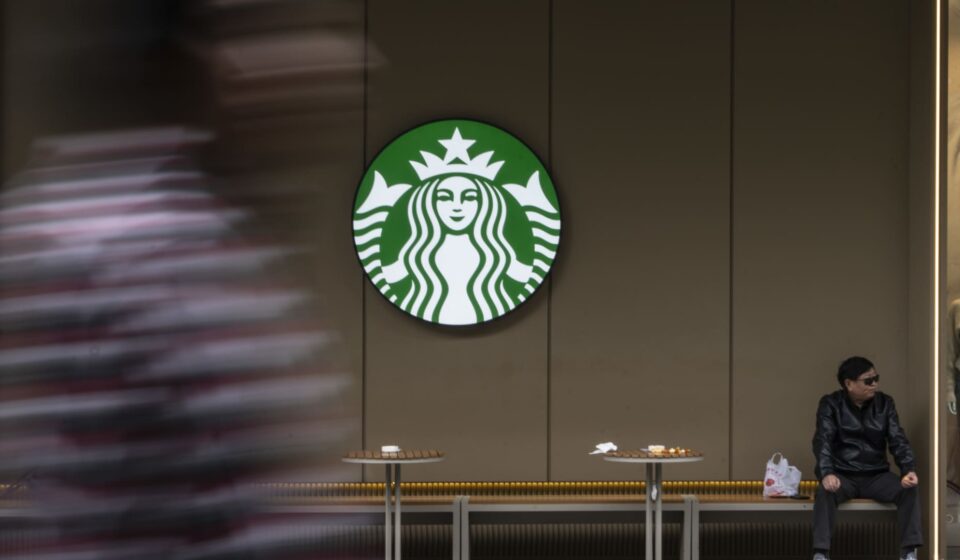

CHONGQING, CHINA – OCTOBER 7: A Chinese national flag is displayed near a Starbucks store during the National Day Golden Week holiday on October 7, 2025, in Chongqing, China.
Cheng Xin | Getty Images News | Getty Images
Hi, this is Anniek, writing to you from Singapore. Welcome to the latest edition of The China Connection — a snapshot of what I’m seeing and hearing from local businesses.
Starbucks struck one of Asia’s most closely watched deals last year, selling a majority stake in its China business to a local private-equity firm. Now it is getting headaches at home over choices made by a partner that increasingly leans toward Beijing’s priorities.
The big story
Starbucks Corp has taken its green apron to Xinjiang, a region where Western governments accuse Beijing of widespread human-rights abuses and where the U.S. restricts imports over forced-labor concerns.
The opening of two stores in Urumqi shows how the Chinese private-equity firm that now controls Starbucks’ business in its second-largest market is willing to weather Washington’s anger.
Starbucks completed the sale of a 60% controlling stake in its China operations to Boyu Capital in April. The venture aims to grow from roughly 8,000 stores to as many as 20,000, and Xinjiang appears to be a bold, if controversial, first stop.
The U.S. House Select Committee on China called the decision «shocking and morally bankrupt» for «a company that prides itself on social responsibility» and demanded the stores close. Its chairman, Rep. John Moolenaar (R-Mich.), was blunt in that statement headlined «Starbucks Serves Up Venti-Sized Genocide.»
China’s Foreign Ministry rejected the criticism, calling U.S. claims of genocide «a blatant lie» and saying Xinjiang has emerged as a region of «social stability, economic prosperity, ethnic unity and religious harmony.» Beijing has long defended its security crackdown as necessary to counter terrorism and religious extremism, and denies allegations of «crimes against humanity» and ongoing repression.
Boyu — run by people who know China’s politics well — wouldn’t have missed the risk, said Ivy Yang, founder of Wavelet Strategy. «Boyu understands the sensitivity of Xinjiang as well as anyone,» she said. In her view, the decision shows the firm weighed Washington’s reaction and concluded that the domestic commercial opportunity mattered more.
The Hong Kong-based private-equity firm, co-founded by Alvin Jiang, a grandson of the late President Jiang Zemin, has long been seen as having close ties to China’s political elite.
Starbucks has been losing ground on price and speed to local rivals, Yang said, and a new owner who’s under pressure to deliver growth is likely to go where the stores aren’t yet.
Molly Liu, chief executive of Starbucks China, in a recent statement, pledged to keep investing in the region.
Business vs geopolitics
Some, however, believe Starbucks’ store openings cannot be read as a purely commercial decision.
«Chinese authorities have a strong interest in attracting prominent global brands to Xinjiang to demonstrate the region’s stability,» said Dan Wang, China director at Eurasia Group.
Beijing has spent years courting investment in Xinjiang. Supporting the region economically became a state goal after the controversy over Xinjiang cotton, said Yaling Jiang, founder of consumer consulting firm ApertureChina, and state television and social-media content have since turned it into a consumer aspiration.
But Xinjiang remains among China’s poorer regions. Its full-year rural per capita disposable income only just topped 20,000 yuan ($2,983) for the first time last year, compared with 24,456 yuan for rural residents nationwide. The non-metropolitan median household income in the U.S. was $60,459 in 2023.
More than a dozen American brands have already ventured into Xinjiang, including Pizza Hut, KFC, McDonald’s, Tesla and Burger King. But few have drawn comparable criticism from U.S. lawmakers.
And that expansion has gathered pace since 2023, according to GeoHey Brand Insights, a geospatial-data research firm, despite the landmark Uyghur Forced Labor Prevention Act signed into law in December 2021.
«Worsening geopolitics is inevitable, and must be priced into any exit negotiation,» said Meng Shen, director of Chanson & Co., a Beijing-based boutique investment bank, of multinationals’ interest in joint ventures with Chinese partners.
With U.S.-China ties steadying this year, Starbucks’ Xinjiang stores are now a test of the climate for American business in China, Wang said — if Starbucks ultimately halts the project under U.S. pressure, it would send a negative signal to American businesses in China that commercial commitments can be overridden by political pressure from Washington.
That could make U.S. brands even more wary of Chinese partners and future deals harder to negotiate, she said.
Need to know
‘Unwelcome and unsafe’: Why Japanese companies are retreating from China at a historic rate
Japanese companies are leaving China in record numbers, as a slowing Chinese economy and a diplomatic freeze force businesses to reassess their presence in the world’s second-largest economy.
China wants in on U.S. AI data center boom. Here’s why
Chinese manufacturers are eyeing the U.S. data center buildout as an opportunity, even as the two countries compete for AI dominance. «We can see very big potential in the U.S. market,» said S.K. Lee, a global vice president at Singapore-registered Brightray, an AI infrastructure company. «The China market is equally important, but we can see that there’s a stronger demand in the U.S.»
Big Pharma’s China deal spree grows with latest tie-up worth up to $7.8 billion
Novartis signed a deal worth up to $7.8 billion with China-based Abogen Biosciences for an mRNA therapy for autoimmune disease, the latest in a run of tie-ups between Big Pharma and Chinese biotechs.
Coming up
Oct 1-7: China’s National Day holiday
Oct 7: China’s foreign-exchange reserves for September
Oct 8-9: Second round of the EU-China trade and investment consultations in Beijing
Oct 9: China’s September new yuan loans and total social financing data
Fuente:
Leer la noticia original