

When our team spoke to Arjun on July 25, he was joyous (“Arjun” is a pseudonym. For security reasons, we have changed the names of all of the protesters). He had just attended the New Delhi protest convened by the Cockroach Janta Party (the Cockroach People’s Party or CJP). The so-called CJP is a satirical group and youth movement whose name is a play on the BJP, the party of Indian Prime Minister Narendra Modi, which has been in power since 2014.
Arjun said that the atmosphere was joyous in Jantar Mantar, a public space in the heart of the capital where the protests have been held, when Education Minister Dharmendra Pradhan resigned:
“The resignation [Editor’s note: of the Minister of Education Dharmendra Pradhan] was around 2:30 pm. Then, people started cheering and celebrating. People were helping each other out – like someone is providing water for free, someone is giving food. Mostly, they were students but millennials [Editor’s note: people in their 30s or 40s] were also present there and some old people, too. They were cheering for us, saying that we’ve done a great job standing up against the government.”
This is only the second time that a minister from the BJP has been forced to resign because of a popular movement. The last, MJ Akbar, resigned as Minister of State for External Affairs in 2018. A number of women accused him of sexual harassment, allegations that marked the rise of the #MeToo wave in India. Arjun added:
“The Modi government has had a myth that none of their ministers has ever resigned. So we made them bend down. That was our biggest win for the moment.”
‘These protests are so big because everything depends on education in India’
Like other members of the movement, which began more than a month ago, Arjun has been calling for the minister’s resignation. They blame him for problems within the Indian higher education system and the repeated scandals that have surrounded a number of different competitive examinations.
Angad, another member of the movement, told us about the origins of this anger.
“It started with a statement from our Chief Justice of India. That’s our Supreme Court. He said something that is really objectionable for the youth of India. He said the youth of India right now are like cockroaches. They don’t work. [Editor’s note: That’s where the name Cockroach People’s Party comes from].
So in India, examinations are like the topmost priority for students. They allow us to get into state colleges or universities and then to go for a government job.
Everyone has to take these examinations, rich or poor. But some people with good connections or with the money to pay manage to get information about the contents of these tests. That’s how the leaks start. When people realise what is happening, the exams are cancelled.
That happened with the NEET exam, which anyone who wants to go to a medical undergraduate program in India has to take – if they want to be a doctor or a nurse for example. It was cancelled this year, which is a disaster for the poorest students.
Some of the students have been preparing for these examinations since high school; they’ve been studying for three or four years.
These students are really young; some of them are barely 18 years old. Some of them decide to die by suicide. There are 22 people who committed suicide because of the exam leaks this year. I even met people amongst the protesters who were there because a loved one had died by suicide. These protests are so big because everything depends on education in India. The leaders need to take responsibility.”
‘Police were hitting students as if they were worse than animals’
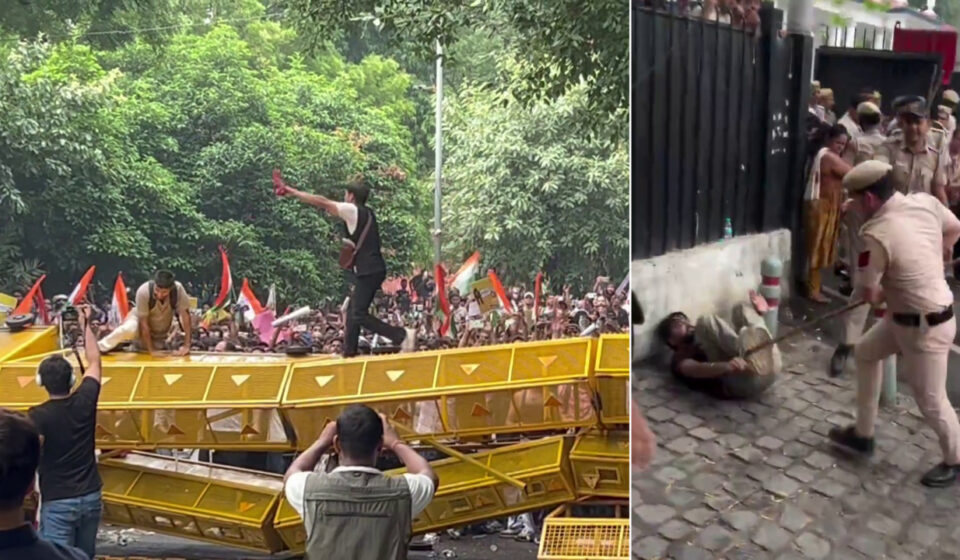
While the “cockroaches” called for “peaceful” protests, one day of violence in particular marked the protests. On Monday, July 20, protesters with the student movement wanted to march on the Indian Federal Parliament, located near Jantar Mantar. The police tried to stop them using force, even though there were nearly 50,000 people taking part, according to local media outlets. Arjun remembers that day:
“After 11:30 or 12, everything kicked off. We wanted to move towards the parliament. And police [were] just there, barricading all the entry points. But we were saying we want to go there. We want them to hear us. But they were literally using force, tear gas, tear gas grenades and pellet guns. But mainly, they used ‘lathis’, big wooden batons.
Police were hitting students as if they were worse than animals. Then the police started baton charging minor students [Editor’s note: underage students], some 15- or 16-year-old girls. And they were directly hitting on the heads. People got injured. Some had open, bleeding skulls; their heads were cracked. I got bruises on my hands and thighs.”

Photos, widely shared online, confirm Arjun’s account. The photos show police armed with long batons hitting protesters, some of whom were already on the ground.
Others show them using tear gas grenades in reckless ways, including throwing one at a seated man, who was thrown by the explosion.
Protesters took images of their injuries or those of their fellow demonstrators.
A few photos do show protesters attacking security forces or throwing rocks at them.
‘I stopped in front of a police van, and I realised that my face was on a monitor’
Most of the people who spoke to the FRANCE 24 Observers team said that the police have not been intervening directly in more recent protests, which have been much calmer. But for those students who did participate, the fear of being identified and experiencing some kind of repression down the line is real.
In the days following the education minister’s resignation, some large universities in the capital published statements calling on their students to avoid participating in the movement and warning them about the potential consequences on their future careers.

A fear that has only been increased by the fact that devices that can carry out surveillance as well as facial recognition have been installed near Jantar Mantar.
Srishti Jaswal, a local independent journalist, documented the use of these systems by the security forces in police vans parked by the entrances to the protests.
“I was filming the demonstrations in Jantar Mantar, looking at the different means that the Delhi police have to carry out digital surveillance and facial surveillance. While I was filming, I stopped in front of a police van that had a monitor, and I realised that I was on it. It was a really scary thing for me because I didn’t anticipate that while I was covering a story about facial recognition software, I would be subjected to it too. The officer did not overtly confess that he was spying on me, but he just blamed it on the cameras. He said they would automatically zoom in on people.
The Delhi police have facial recognition systems that they use for managing traffic, crowd control and identifying criminals. They developed these systems for the G20 summit held in India in 2023. They’ve used them during a variety of protests but never to this level because this is one of the biggest protest movements we’ve seen in recent years.”
Students arrested, then released
Similar to the fears expressed by protesters that they might be identified, the spokesperson for the Cockroach Junta Party posted a statement on July 27 where he said that students and other protesters were “being targeted, detained, or arrested by various state agencies”.
Viral videos on social media, many picked up by the Indian opposition, claim to show the arrests of student protesters at their homes. Our team was able to geolocate one of them to the city of Patna.
Patna is located in the state of Bihar, where student protests have been particularly violent, especially on July 25. According to local authorities, 93 state officials and 13 civilians were reportedly injured during the unrest.
Videos show some police officers opening fire, including one using an assault rifle in the city of Siwan. That officer has since been suspended.
In Bihar, 694 protesters – half of them minors – were reportedly arrested. The state government subsequently announced on Monday, July 27, that all charges would be dropped following national-level negotiations with the «Cockroach Party».
This article has been translated from the original in French by Brenna Daldorph.
Fuente:
Leer la noticia original