
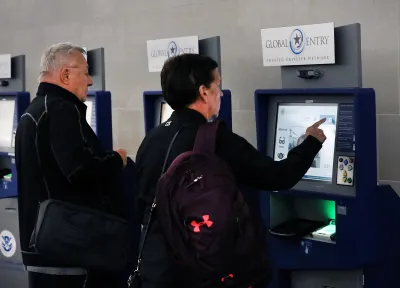

U.S. Customs and Border Protection is gearing up for an influx of international passengers coming to the U.S. for this summer’s FIFA World Cup. In this file photo from 2025, CBP officers process passengers arriving to the U.S. on international flights at Baltimore/Washington International Thurgood Marshall Airport. CBP photo by Glenn Fawcett
The world comes to America – and Canada and Mexico – this summer, as the three countries host the FIFA World Cup. U.S. Customs and Border Protection will play a significant role in making sure the event is safe and secure for all players and attendees. That starts with close coordination, not just with American federal, state, and local law enforcement, but the U.S.’s counterparts in Mexico and Canada.

“We coordinate efforts to provide a seamless and secure experience for all travelers and participants of the World Cup,” said Casey Durst, executive assistant commissioner of CBP’s Operations Support and the senior component accountable official for World Cup 2026. “To achieve unified command and rapid response throughout the tournament, we established the CBP World Cup Task Force – a structure that coordinates security operations, reports activities, and deploys specialized capabilities across all FIFA World Cup 2026 host cities.”
CBP has already been coordinating with the U.S. Department of State to approve visa applications for the estimated 6 million-plus international visitors expected to come to the event, as well as the U.S. Departments of Justice and Commerce that regularly engage with external industry stakeholders. Just from Oct. 1, 2025, to April 30, 2026, CBP already processed and approved more than 5 million Electronic System for Travel Authorization – or ESTA – applications and enhanced the Trusted Traveler Programs to help make sure there is secure and efficient travel as part of the ongoing preparations for the FIFA World Cup. During the same period, CBP processed over 1.6 million applications for Global Entry, Secure Electronic Network for Travelers Rapid Inspection – known as SENTRI – and NEXUS, which allows prescreened travelers expedited processing when entering the U.S. and Canada.

“CBP is committed to ensuring safe and lawful travel for all visitors attending the FIFA World Cup 2026,” said Matthew Davies, executive director, Admissibility and Passenger Programs, with CBP’s Office of Field Operations. “By expanding participation in our Trusted Traveler Programs and ESTA, we are helping all travelers spend less time in line and more time enjoying their experience in the United States, while maintaining strong border security.”
In addition, CBP’s Office of Field Operations – the blue-uniformed officers checking passports and processing passengers, as well as inspecting all shipments coming into the U.S. – has enhanced its coordination with local law enforcement and international partners to secure cross-border movements and conducted pre-event tabletop exercises and drills with partner agencies to prepare for various scenarios. The office has also increased the number of officers, expanded hours, put in place advanced screening technologies, and improved layouts at key ports to handle higher international arrivals. Dedicated procedures for credentialed personnel, multilingual support and enhanced traveler outreach will help ensure efficient and secure processing.

CBP is also working closely with partner government agencies – including the U.S. Department of Agriculture, the Centers for Disease Control and Prevention, and the Food and Drug Administration – to inspect agricultural goods and biological materials entering the country for the FIFA World Cup 2026. These collaborative efforts ensure that all imported products meet strict safety and health standards, helping prevent the introduction of harmful pests, diseases and contaminants.
CBP is used to helping with security for high-profile events like this. Every year, the agency contributes significantly to security measures at the Super Bowl, providing extra personnel for enhanced X-ray operations for all of the goods and vendors that go into the stadium area, as well as providing the no-fly zone around the stadiums and performing intellectual property rights inspections on the merchandise imported for the tournament to make sure consumers aren’t unwittingly buying counterfeits from vendors at the matches.
Counterfeits are often sold at unusually low prices, which can be tempting for consumers. However, they can pose real safety threats. CBP is working hard to protect FIFA fans and all Americans from these threats. CBP has the authority to detain, seize, forfeit and ultimately destroy counterfeit and pirated goods arriving at U.S. borders. In fiscal year 2025, CBP seized over 1.8 million counterfeit apparel and footwear items, which equates to a manufacturer’s suggested retail price of over $247 million, had this merchandise been genuine. To combat this trend, CBP has ramped up its intellectual property rights enforcement training efforts to make sure CBP officers and trade specialists are equipped with the latest information needed to detect and interdict shipments of counterfeit and piratical FIFA World Cup merchandise. Counterfeits are not manufactured using the same standards as legitimate goods and thus are often made with harmful materials and inferior components. CBP’s anti-counterfeiting public awareness campaign, The Truth Behind Counterfeits, encourages the public to shop smart to avoid the negative impacts associated with the purchase of counterfeit goods, including FIFA products.
“If the price of your favorite team’s jersey seems too good to be true, it probably is,” said Susan S. Thomas, the executive assistant commissioner for CBP’s Office of Trade. “CBP works to keep counterfeit merchandise out of the country, so soccer fans stay safe during the 2026 FIFA World Cup.”
Fuente:
Leer la noticia original
