
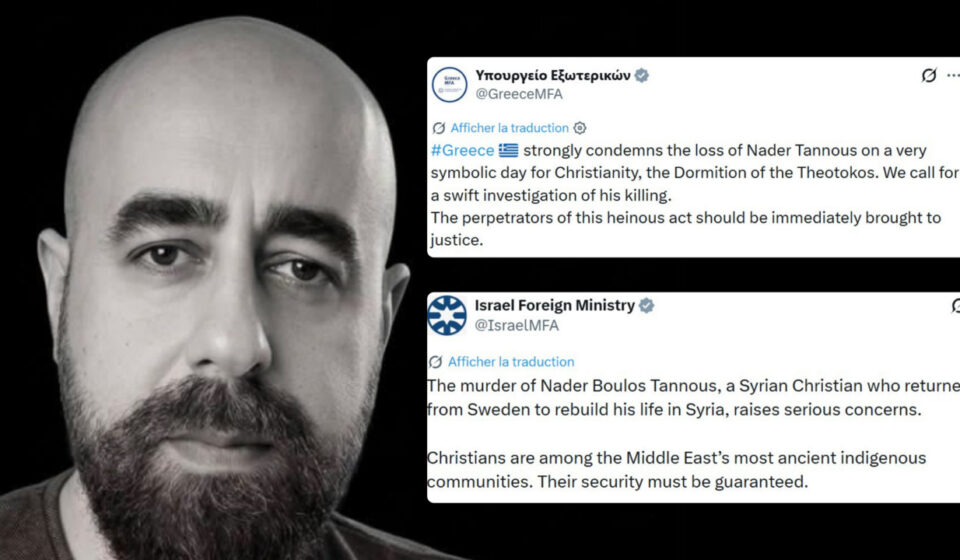

Nader Boulos Tannous, a Syrian Christian who was shot and killed on August 15, 2026 in the city of Homs, has been turned into a symbol for the country’s Christian community by advocates. Tannous, who had lived for years in Sweden, moved back to Syria recently and opened a women’s beauty salon.
In the days following his murder, a number of countries released statements denouncing what they called an anti-Christian act. One of the first reactions came from the Israeli government: Tannous’s death “raised serious concerns”, according to a post dated August 18 on the official English-language X account of the Israeli Ministry of Foreign Affairs, which denounced what they said was a lack of protection for Syria’s Christian community. “Christians are among the Middle East’s most ancient indigenous communities,” the post read. “Their security must be guaranteed.”

Both the Greek and Cypriot governments also commented on Tannous’s death, which occurred on the Feast of the Dormition, an important day for the Eastern Orthodox churches. Both countries called for an investigation into the death.
A personal dispute going back to 2012
However, the initial findings of Syrian investigators have not pointed towards an anti-Christian act, but instead towards the victim’s past.
On August 25, the commander of interior security in Homs told Syrian media outlet Syria TV, that a suspect had been arrested 48 hours after Tannous was killed. According to city authorities, the suspect admitted to the killing and said he had done so because “of a dispute between him and the victim going back to 2012.”
Our team spoke to Colonel Bilal Al-Aswad, the deputy chief of police in Homs, who said that the suspect – whose first name is Yahya – said that he had been seeking “revenge”.
Police said that they obtained “several witness statements” from locals, who all confirmed that Tannous was «a member of the former regime [of Bashar al-Assad]” and had “taken part in the Karam al-Louz massacre», during which he carried out “violence against unarmed civilians.”
This massacre – named after a neighbourhood in Homs – took place in early 2012, when the city was under siege by Assad’s regime. At the time, the opposition reported that 15 were killed, according to Al Jazeera.

131st victim of revenge and execution
Another theory about the killing was reported by Syrian journalists on X, who said that Tannous was suspected of both violence and sexual abuse towards the niece of the suspect. Our team also spoke to a family member of the person allegedly abused by Tannous, who also confirmed this version of events. The police, however, did not confirm these details, instead saying that they wanted to “preserve the confidentiality of this information until the end of the investigation” due to its sensitive nature.
For now, there is no evidence linking Tannous’s killing to any kind of anti-Christian sentiment.
Several Syrian media outlets, including Syriacpresse – which reports on Christian communities in the Middle East – also reported on the murder. They included the same information given by the authorities and did not mention any possible religious motive.
The Syrian Observatory on Human Rights also reported the details released by the Homs police. They classified Tannous as the 131st victim of “vengeance attacks and execution operations” in the country since early 2026.
Deputy chief of police Colonel Bilal Al-Aswad called on citizens to «exercise their rights by the legal route” and not to commit such “crimes.”
‘Isolated’ anti-Christian acts of violence in Syria
More widely, there have been some anti-Christian attacks in Syria since the fall of the Assad regime in December 2024.
Our team spoke to the Syrian Network for Human Rights (SNHR) – an organisation created at the beginning of the war in Syria in 2011 – which said that it had documented “a number of isolated incidents targeting the Christian community.” For example, at least 25 people died in June 2025 when a terrorist group linked to the Islamic State group carried out a suicide attack on a church in Damascus.
The SNHR said that it had not seen evidence for an “official state policy” against Christians.
“The data we have does not indicate that these incidents are part of a systemic plan or policy targeting Christians because of their religious convictions.” The body added that the Syrian authorities had “intervened to resolve these incidents”.
The SNHR also said that the acceptance of Christian religious practices had improved since 2025.
«Syrian Christians have been practising their religious traditions, celebrating their holidays and openly displaying their customs and traditions, and we have not observed any general tendency to restrict these practices.”
However, Aaron Zelin, a researcher at the Washington Institute, wrote in December 2025 about “an atmosphere within the [Syrian Christian] community of unrest and suspicions regarding whether the new authorities are truly willing to protect them, even while the Syrian government has provided better security at its churches.”
Fake news about Christian massacres
Violence against minorities remains a concern in Syria, especially for the Alawite, Kurdish and Druze populations, who have all experienced increased violence since December 2024.
In March 2025, Syria’s new authorities launched a sweeping operation after clashes with fighters loyal to the deposed Assad regime. More than 1,300 people died in the resulting violence, including numerous Alawites killed by forces linked to the new government.
Read moreAre Christians being massacred in Syria?
A dozen Christians were also killed in the violence. At the time, conservative politicians in France – including French presidential candidate Bruno Retailleau – started sharing rumours that Christians were being massacred.
But observers, including the Syriac Catholic Archbishop of Homs who spoke to French Catholic newspaper La Croix as well as representatives from Christian churches in the town of Latakia, said that Christians had not been direct targets.
This article has been translated from the original in French by Brenna Daldorph.
Fuente:
Leer la noticia original