
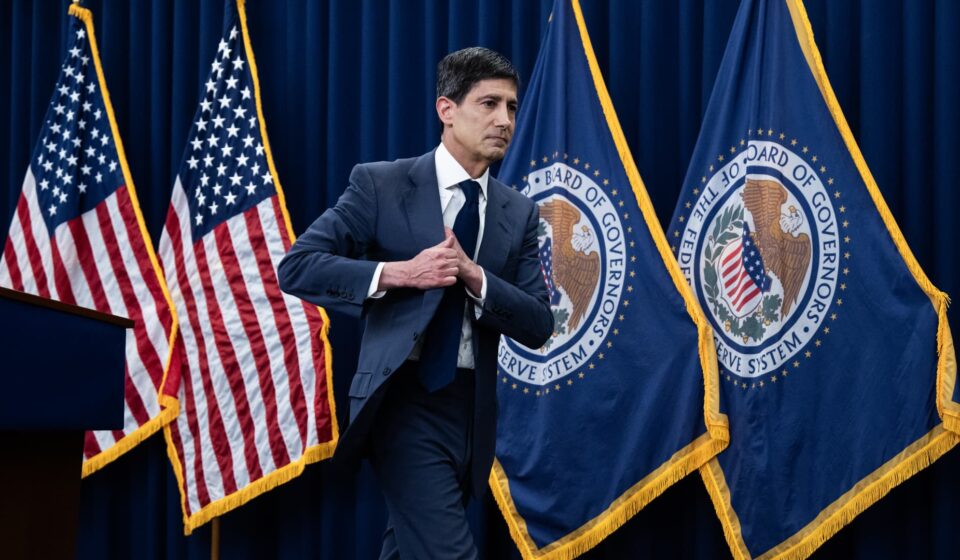

Federal Reserve Chairman Kevin Warsh concludes a news conference after a meeting of the Federal Open Market Committee, June 17, 2026.
Tom Williams | CQ-Roll Call, Inc. | Getty Images
The Federal Reserve is expected to hold interest rates unchanged at its upcoming July meeting — as higher energy prices and renewed tensions with Iran have complicated the picture for Fed Chairman Kevin Warsh, despite cooler inflation data.
While Warsh took over a Fed that has seen inflation exceed its 2% target since 2021, the consumer price index — a broad measure of inflation — posted an unexpected decline last month, bringing the annual inflation rate down to 3.5% in June. But in the weeks that followed, oil prices jumped again amid the escalating conflict in the Middle East.
Traders scaled back expectations for an interest rate hike when the Fed meets this week, according to the CME Group’s FedWatch gauge. Market pricing indicates the Fed is more likely to consider a rate move in September.
For Warsh, price stability remains a headwind, despite President Donald Trump’s push to bring the federal funds rate down, according to Brett House, an economics professor at Columbia Business School. «It sets up a potential conflict between Trump and the Fed, where his desire for lower interest rates is unlikely to be realized anytime soon,» he said.
How the Fed affects your wallet
The Fed’s benchmark interest rate determines what banks charge one another for overnight loans. That rate then influences a wide range of consumer borrowing and savings rates.
When the Fed raises its benchmark rate, borrowing becomes more expensive, which can slow economic activity and help ease inflation. Lowering the rate tends to encourage spending and stimulate the economy, but can also contribute to rising prices.
Shorter-term rates are closely pegged to the prime rate, which is typically 3 percentage points above the fed funds rate. Longer-term rates are more dependent on inflation expectations and other economic factors.
«Consumers need to remember that the rates that they face are not set only by the Fed. The bond market has a big hand in determining the rates consumers pay,» House said.
The yield on the 10-year Treasury note, which underpins mortgages and other longer-term loans, was up 5 basis points on Thursday. «That’s going to keep borrowing costs higher for consumers both on short-term borrowing and the longer-run loans,» House said
For example, 15- and 30-year fixed mortgage rates typically follow the lead of Treasury rates and the economy. «Mortgage rates are holding just above 6.50%, as encouraging inflation data is being offset by higher oil prices and renewed tensions between the U.S. and Iran,» said Jeff DerGurahian, LoanDepot’s chief investment officer and head economist.
Auto loan rates are tied to several factors, including the Fed’s benchmark. Since financing costs remain elevated, car buyers are taking on larger and longer loans to combat affordability challenges in the car market, according to the latest data from Edmunds.
Although federal student loan rates are fixed for the life of the loan, rates will rise for new borrowers in the year ahead based on the last 10-year Treasury note auction in May.
By contrast, most credit cards carry variable interest rates, which are tied more directly to the Fed’s benchmark. However, with the Fed expected to keep rates unchanged, credit card APRs are likely to remain elevated, as well. The average interest rate on a new credit card offer is currently 23.79%, according to LendingTree.
«The average has been remarkably stable, remaining unchanged in three of the past four months,» said Matt Schulz, LendingTree’s chief credit analyst.
Savings rates also tend to be correlated with changes in the target federal funds rate. Therefore, holding that rate unchanged has kept savings yields relatively high.
«It’s still a good time to save,» Schulz said. «CD and high-yield savings account rates are down from their peaks seen a few years ago, but they’re still strong by historical standards and are likely to remain that way for a while.»
Fuente:
Leer la noticia original