
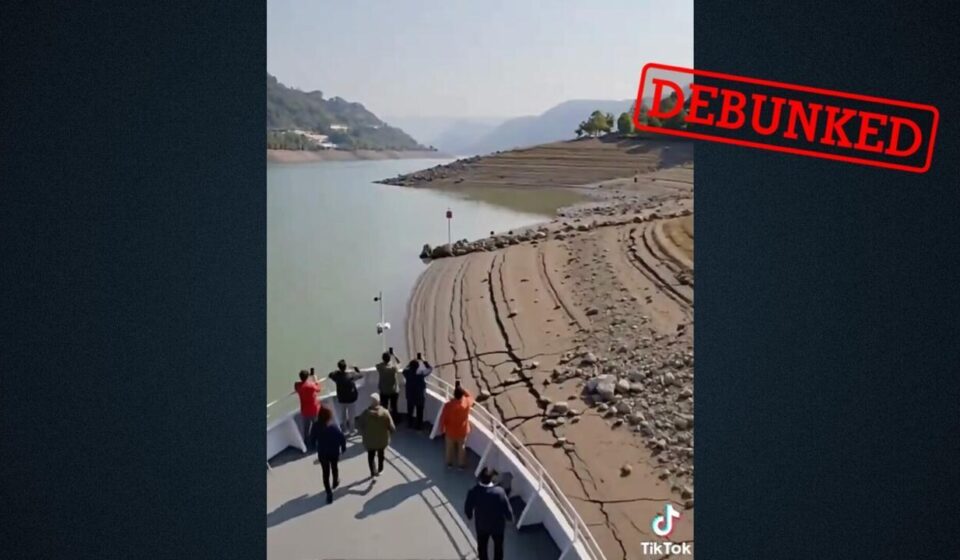

Did one of Italy’s most celebrated lakes dry up? That’s the claim made by a report that has garnered more than 600,000 views on X and TikTok: that Lake Como, in northern Italy, is now empty:
“One of Italy’s most celebrated landscapes has turned into an immense field of mud, rocks and stranded boats. The first images were filmed in Bellagio [a town located on the banks of the lake – Ed]. You can see the water disappearing at astonishing speed, leaving jetties suspended above the void,” says the narrator of the report. The “journalist” hypothesises that the lake has emptied because of a “geological rupture”.

There’s just one thing. These shocking images of a dried-up Lake Como are false. They were generated by artificial intelligence.
The lake is still full of water
We were able to identify the TikTok account that first posted this video thanks to the watermark on it. The account is called @naturevsia. The description on the profile leaves no doubt as to the origin of its videos: “AI News”. It turns out this is a fake media outlet that produces sensational and false videos. There is a warning on the account that all of its videos are AI-generated.
While some people quickly determined that the video was a fake, others were convinced it was real, including some viewers in the Democratic Republic of the Congo and Burundi (see their comments here and here).
As you can see in the image taken by the European satellite Sentinel 2 on August 13 visible on the Copernicus website, Lake Como, which has a 170-kilometre perimeter, is still full of water.

Moreover, images from August 14 recorded by a webcam located in the town of Tremezzo, to the west of Bellagio, show that the water in this part of the lake hasn’t receded, contrary to the claims made in the AI-generated report.

Drought is affecting Lake Como
While Lake Como did not empty out thanks to a “geological rupture” as claimed by the AI-generated report, its water levels are dropping due to drought. Italian local media outlet La Provincia di Como reported that, by August 1, the waters in the lake had dropped «at least 30.2cm below the hydrographic zero” [a base value from which you can measure changes in the lake – Ed.], making it close to “the lowest water levels hit four years ago”.
This drop in water levels does not mean, however, that the lake will disappear. Its maximum depth is 418 metres.
This article has been translated from the original in French by Brenna Daldorph.
Fuente:
Leer la noticia original