


TEXAS — Mason McCallister said it was an act of God that sent him down a gravel road near his home in Bells, Texas, one Sunday last December.
It wasn’t the normal route he and his family take back from church, but he decided to detour so his daughters could shout hello to their grandmother as they drove by her home.
What he saw that day catapulted him into a debate playing out around the country — and especially in Texas — over data centers. It’s one that may now affect the outcome of key elections in the Lone Star State.
As they rolled past, flashes of red caught McCallister’s eye among the lush green of the area’s gentle hills.
«Driving down that road, I just see survey markers everywhere,» McCallister, a real estate agent, told CNBC. «And I knew at that time what was happening. I could feel it» — a data center is coming, he said.
Mason McCallister, a real estate agent who has argued for stricter regulations and more transparency around data center development, near his Bells, Texas home.
CNBC
McCallister’s home is less than a mile from the survey markers, in a rural stretch between Dallas and the Oklahoma border. He and his wife, Heather, built the house on 26 acres, where they keep three horses and a donkey and host frequent family gatherings at a long farmhouse table on their spacious back patio.
The outcry over data centers — warehouses that contain the hardware for powering artificial intelligence and other technology — was only a faint murmur when McCallister first saw the survey markers. In the months since, it’s become a dull roar, as increasingly more projects are proposed and built, and general anxiety over AI and its potentially humanity-ending powers grows.
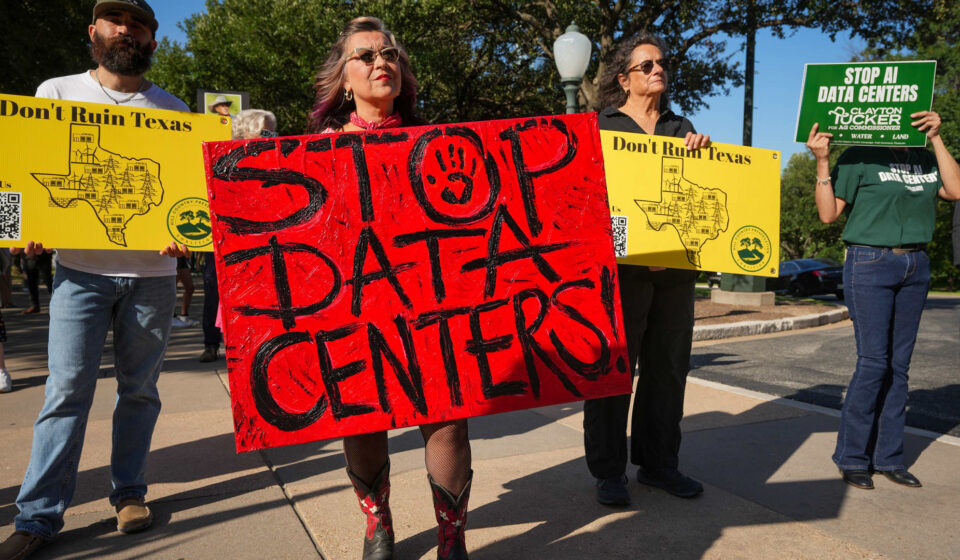
Across Texas and the country, people have flooded local meetings to protest proposed projects, citing concerns about the use of water and other resources, noise and light pollution, rising utility costs and falling property values. Some towns and cities have moved to block their development, as anti-data center advocacy groups and social media pages proliferate.
Polling shows the economy and cost of living are top of mind for voters in the runup to the 2026 midterm elections. But some political strategists say data centers are a potent enough issue that they could shift the balance of power in Texas, potentially paving the way for Democrats to win statewide for the first time since 1994. Democrats have their sights set on the governor’s mansion, as well as an open U.S. Senate seat, and the outcome of the Senate race could determine control of Congress.
Populists on both the left and the right — including Sens. Bernie Sanders, I-Vt., and Josh Hawley, R-Mo. — were quick to try to rein in data centers and protect consumers against associated utility cost increases. But Democrats have broadly staked out a clear position against data centers, as President Donald Trump cheers development of new facilities.
That dynamic has left Republicans — including Texas Gov. Greg Abbott, who is running for reelection, and Texas Attorney General Ken Paxton, who is running for Senate — playing defense as public opinion turns against the facilities.
«I don’t think Republicans have a clear, standard message on data centers and AI at this moment,» said Brendan Steinhauser, a GOP strategist and CEO of The Alliance for Secure AI Action, who has called data centers a «sleeper issue» of this election cycle.
The survey markers set McCallister on a hunt for answers that included knocking on neighbors’ doors, approaching surveyors in fields near his house, chasing down local officials and eventually cornering Rhett Bennett, the CEO of Black Mountain, a Fort Worth-based energy and natural resources development company he discerned had designs on the land.
Black Mountain did not respond to multiple requests for comment from CNBC about the potential project. But McCallister said Bennett — whom he confronted at a public meeting, with a Texas Tribune reporter in tow — confirmed the company was exploring a data center near his house. McCallister fears that if it is completed, it could effectively envelop his property.
Mason McCallister with his wife, Heather, and their two daughters, at their home in Bells, Texas.
CNBC
McCallister said he and his wife never planned to sell their house, so any potential hit to their property value isn’t particularly worrying. He says his primary concerns are water and power usage. Other data center opponents CNBC spoke with in Texas said they were concerned about noise and light pollution as well as the long-term economic and job displacement impacts of AI, which some of the facilities power.
More than anything, the ordeal has made McCallister — who said he’s a lifelong Republican and voted for Trump three times — question his political leanings. The GOP, he said, has been too slow to react.
«I’m definitely frustrated with the Republican Party. I have gone literally out of my way to warn them, to tell them what’s happening,» he said. «Y’all should have picked up on this much earlier than y’all did.»
‘Let Data Reign’
Trump’s outright dismissal of data center concerns and his reluctance to regulate rapidly evolving AI have complicated the issue for Republican leaders such as Abbott and Paxton, who are fighting for their political lives in one of the most closely watched states in the 2026 election.
«The only reason that communities throughout the U.S.A. should not want Data Centers is if they want to end up being backwards and poor. If they want to be successful and rich, with far lower taxes and jobs all over the place, let Data Reign,» Trump posted on Truth Social on Aug. 31.
With Trump’s unyielding stance on the issue, Abbott and Paxton face a dilemma: Either they defy Trump, the de facto head of the Republican Party, and their donors with tech and data center-industry connections. Or they anger a sizable bloc of data center opponents that has emerged within their base.
Fifty-seven percent of Texas voters polled by the Texas Politics Project said they opposed a data center being built in their community, including 43% of Republicans, 54% of independents and 60% of rural voters.
The cross-partisan grassroots movement could threaten Republicans’ hopes of keeping Texas red in what is already expected to be a difficult year for the GOP, amid high consumer prices and Trump’s falling approval ratings.
«This issue is politically toxic, and if Republicans have a message that says let Big Tech run wild and let them do these hyperscale data centers all over the country, Republicans are going to pay a price at the ballot box,» Steinhauser said, though he said he sees the GOP starting to coalesce around a stronger, pro-regulation platform.
Amid that political environment, both Texas GOP leaders have dipped their toes into data center opposition in recent months.
Texas Governor Greg Abbott takes the stage at the Republican convention in Dallas, Thursday, Sept. 10, 2026. (Smiley N. Pool/The Dallas Morning News via Getty Images)
Smiley N. Pool | The Dallas Morning News | Getty Images
Abbott — who is polling slightly ahead of Democratic state Rep. Gina Hinojosa in a race the Cook Political Report with Amy Walter labels «likely R» — in 2015 signed legislation creating new sales tax exemptions for large data centers and as recently as November called Texas the «epicenter of AI development.»
But Abbott in recent months has shifted his posture toward data centers. In August, he unveiled a new plan that instructs state regulators to audit all proposed data centers seeking to connect to Texas’ power grid before allowing projects to proceed. Abbott went a step further this week, ordering the state’s environmental regulator to halt all data center-related permits, including those that aren’t seeking to connect to the state’s power grid, while an audit of the existing waitlist is completed. He’s also suggested the state legislature, which will not meet again until 2027, repeal the data center tax break.
Paxton — who has faced scandals including a 2023 impeachment over corruption allegations, in which the state Senate acquitted him, and felony securities fraud charges, which were dropped in 2024 — voted in 2013 as a freshman member of the state Senate in favor of a sales tax exemption for data centers. He also has refrained from issuing an opinion — first sought by local officials in February — on whether Hood County had the legal authority to halt data center development in the area.
But in late August, he introduced a «Texas first» data center plan, which called for the passage of legislation to bar Chinese technology from powering U.S. data centers and hold AI companies criminally liable if their chatbots harm children. Paxton also said he’d support legislation introduced by Sen. Tom Cotton, R-Ark., that would ease federal regulation to allow data centers to build customized electricity systems, sparing the existing power grid and preventing utility cost hikes, according to Paxton.
Paxton’s announcement of the plan, posted to X, was flagged by the social media platform as being «made with AI.»
Both Abbott and Paxton, through their spokespeople, declined multiple requests for interviews.
«Governor Abbott is taking decisive action to ensure data centers pay their own way, protect Texas water and power, and meet strict standards before connecting to the grid,» Eduardo Leal, Abbott’s campaign press secretary, said in a statement.
Abbott has received millions of dollars in contributions from AI and data center interests, including $500,000 donations from xAI founder Elon Musk and from Bennett, the Black Mountain CEO. Paxton’s campaign and affiliated groups have received more than $400,000 from individuals and companies with data center ties, The Washington Sun reported.
In response to CNBC’s questions, Paxton’s campaign, through spokesperson Madison Cercy, shrugged off those contributions and instead attacked his opponent, state Rep. James Talarico, calling him a «hypocrite and a liar.»
Texas Attorney General Ken Paxton, a Republican Senate candidate, speaks on stage on the first day of the 2026 Republican National Convention at the American Airlines Center in Dallas, Sept. 9, 2026.
Kevin Dietsch | Getty Images
A pro-Talarico super PAC, Lone Star Rising, which has spent more than $3 million in support of the Democratic Senate candidate, has received more than $11 million from LinkedIn co-founder Reid Hoffman, a key AI and data center investor.
Campaigns are legally forbidden from coordinating with super PACs, and Talarico has called for the political fundraising groups to be banned.
‘Epicenter’ of a crisis
Anxiety over AI and data centers has only grown following a call to action by former Anthropic employee Jacob Coxon, who resigned from the company, then posted to X: «The people building AI earnestly believe that it could kill us all by the end of the decade.» That prompted Anthropic CEO Dario Amodei to urge other tech leaders to slow AI development, with OpenAI CEO Sam Altman and Musk endorsing Amodei’s call.
«I think data centers brings together a lot of the issues that people are concerned about: cost of living, corruption in our government, artificial intelligence, and the fact that our government seems to be MIA when it comes to creating guardrails for this new technology,» Talarico, who is leading Paxton in most Senate race polls, told CNBC on the sidelines of a food drive in Dallas in early September.
Texas state Rep. James Talarico, the Democratic nominee for a U.S. Senate seat, at a food drive in Dallas, Sept. 9, 2026.
CNBC
«All of those issues are kind of combined in this problem of data centers, and it’s why it’s so emotional for Texans. We’re the epicenter of this data center crisis,» Talarico said.
The Cook Political Report lists the Senate race as a «toss up,» though Republican groups are flooding Paxton with campaign cash in the closing months of the campaign. The new super PAC tied to Trump, the No Going Back PAC, has spent about $935,000 on Paxton.
But as much of Washington scrambles to get its arms around emerging AI risks, elsewhere in the country, opposition to data centers does not necessarily indicate animosity toward AI.
«I never used it,» McCallister said, when asked his thoughts on AI. «I could go the rest of my life without using it, but I know a lot of people can’t. So I’m not pro- or I’m not anti-AI.» When it comes to data centers, he said, «I’m just focused on regulations. Put these in places that make sense for the communities, not places that make sense for the data centers.»
A boon or a burden?
A data center in Texas is pictured. By one projection, Texas is expected to overtake Virginia as the largest global data center market by 2030.
Andrew Evers | CNBC
Data center developments have flooded into Texas, with its pro-business ethos and vast swaths of open land, in recent years. The state could overtake Virginia as the largest global data center market by 2030, according to projections from the real estate services company JLL.
That interest from developers could have benefits, industry advocates argue.
Dan Diorio, executive vice president of state policy and government affairs for the Data Center Coalition, an industry trade group, said projects often come with massive capital investments and added tax revenues that can be reinvested into schools and local infrastructure. Diorio said data centers are also job creators, particularly for construction workers during build-out, and don’t sap natural resources to the extent many opponents believe.
«We see throughout the country data centers using as much, if not less, water than a large commercial office building,» Diorio said.
While Talarico and Hinojosa, the Democratic nominee for governor, have been outspoken in their desire to rein in data center development, both are taking a nuanced position.
Hinojosa has called for a moratorium until laws can be passed to protect people from potential impacts on the environment, local economies or the power grid. Talarico has rolled out a plan that he said would require data center companies to pay for their own energy, recycle water and provide jobs as a condition of being built.
«It’s not a black-and-white issue,» Talarico said. «Because if a community feels like these data centers can be a benefit, then I trust those communities to make those decisions for themselves.»
‘An existential threat’
Texas state Rep. Gina Hinojosa, the Democratic nominee for Texas governor, talks to University of Texas at Austin students at Tejas House, Sept. 10, 2026.
CNBC
On a Thursday night at the University of Texas at Austin, Hinojosa sat in an upstairs common room of a fraternity house.
Downstairs an hour earlier, more than 100 college students had skipped the local bars — or at least delayed their arrival — to hear Hinojosa speak about her campaign. They crammed into the musky parlor of the Tejas Club, where the only beverages that night were of the non-alcoholic variety.
It was the latest in a series of unusual rooms in which Hinojosa has found herself on the campaign trail.
Recently, that included a trip to a home in Red Oak, a suburb of Dallas, where she sat in the host’s living room with a group of data center opponents that she described as «all MAGA.»
«It was people who typically don’t give someone like me a chance. And they were very curious about my campaign. They were very curious about me,» Hinojosa told CNBC in the upstairs living room after the event. To her right, a concert poster for the band Geese hung on a door. Behind her, a shotski — a prop for communal shot-taking popular on college campuses — leaned against a wall in the corner.
There was not universal agreement on all issues in that room in Red Oak, Hinojosa recalled. But the first question the group asked her, she said, was about data centers, one of which is proposed nearby.
«It is a threat to their families, to their homes, to their communities, to their way of life, to their water that they drink,» she said. «So it is, for many Texans, a kind of existential threat. And I have met single-issue voters on it.»
Appealing to those voters will be key for Hinojosa and Talarico in a state where Republicans have dominated for decades. And Talarico, in particular, may have a plausible path to victory. Not since Beto O’Rourke came within a few points of defeating Sen. Ted Cruz in 2018 has a Texas Democrat generated the national attention Talarico has.
But it remains unclear just how many Republicans in deep-red Texas will be willing to defect and how big of an issue data centers are for the average Texas voter.
«Concern about the economy and cost of living remain far and away the most important issue to Texas voters right now,» said Joshua Blank, research director at the nonpartisan Texas Politics Project. Data centers have become a «persistent area of focus,» he said.
But Blank said the question of whether they play a role in determining election outcomes will depend on «broader questions about economic stewardship and whether or not data centers or data center developers are getting preferential treatment when people feel like … their own cost of living is going up.»
Red to blue?
Chris Tronzano is a landscape architect and a «hobbyist» rancher who moved with his wife in 2021 from Dallas County to Fannin County, where they hoped to retire. Shortly after, a battery energy storage system —which can be used to help power data centers — went up next door. Then, they learned a data center could also be coming to the area.
Tronzano, a Trump supporter who said he has always voted straight down party lines for Republicans, said the news scuttled their plans. They sold their property and moved again, this time to nearby Grayson County. The experience soured him on Trump and other Republicans who have advocated for data centers. And it tested his political loyalties.
«Why is he on this huge push for data centers?» Tronzano asked, of Trump. «If they’re so important and so needed for national security, or there’s this fight between us and China — what exactly is it? I don’t think the normal citizen understands it.»
Citing his data center frustration, Tronzano said he likely won’t vote for Abbott this year and is undecided on Paxton. But it’s more likely he’ll skip those races than vote for Democrats, who as a party he feels espouse a progressivism that doesn’t sync with his values, he said.
Ann McCoslin assembles «no data center» signs to place along a county road next to the proposed Crusoe data center, in Jewett, Texas, July 28, 2026.
Antranik Tavitian | The Washington Post | Getty Images
Meanwhile, McCallister said he’s never voted for a Democrat but he’s considering it for the first time. He still hasn’t settled on his choice for governor and Senate, but he said data centers will be the top issue as he makes his decision.
He is soft-spoken and mild-mannered, with a bushy beard that covers the lower quadrant of his face, and he has an aversion to social media. He didn’t set out to get into the weeds of Texas data center politics, but he’s become an unlikely and outspoken grassroots leader on the issue.
Overcoming his social media skepticism, McCallister recently created a Facebook page and launched a nonprofit calling for stricter data center regulations. There, he’s connected with a network of Texans opposed to data centers. He says many are just as disillusioned with the Republican Party as he is.
«No longer do we just vote red all the way down,» McCallister said. «If your elected official is not listening to you … you should replace that person.»
— Luke Fountain contributed to this report.
Fuente:
Leer la noticia original