


Rabbiatu Kuyateh considers the United States her country: “I’ve known it as my home”, she said. It isn’t where she was born, however: she was born and raised in Sierra Leone but fled the civil war there in the 90s. She has now lived in the United States for more than 30 years and has raised her own family there. Kuyateh is a nurse and, throughout this time, she had a series of renewable work permits and never obtained permanent residency. “I worked hard, I paid my taxes,” she said.
But in early July 2025, she was detained during a routine appointment with the Immigration and Customs Enforcement (ICE) in Baltimore, Maryland. After spending four months in detention, she learned that she was going to be deported to Ghana, more than 1,000 km from her country of origin.
“I said, ‘Ghana? I’m not from Ghana; what am I going to do there? I only saw Ghana on the map; I don’t know where that is, ” she told the consortium.
More than 25,000 people have been expelled to third countries
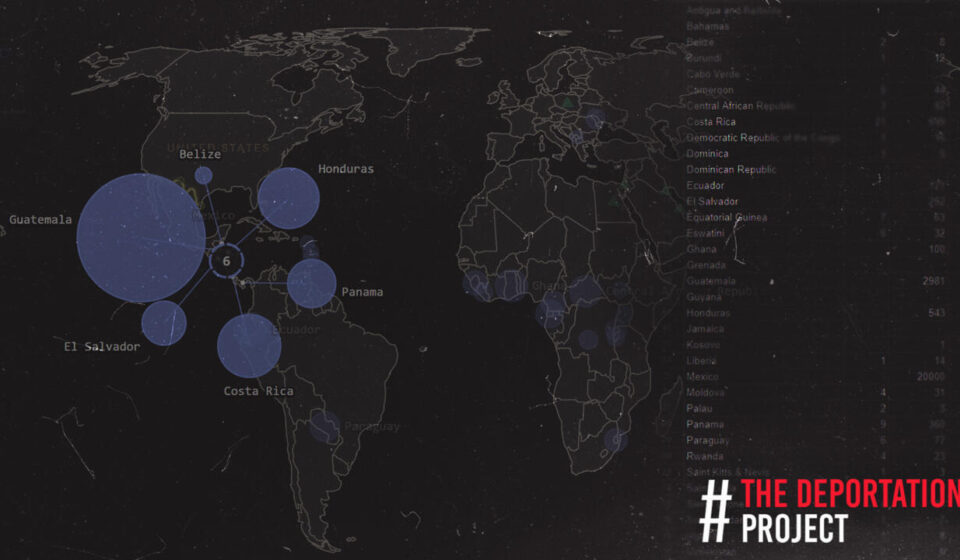
Since Donald Trump took office in January 2025, more than 25,000 people have been deported to a country that is not their home country and with which they often have no ties, according to a count carried out by a team of 26 international media outlets led by Forbidden Stories. A large majority – 20,000 people – were deported to Mexico. Others – at least 5,447 people – had, by August 31, 2026, been taken on deportation flights and dropped all across the globe.
These “third-country removals” have become a core part of the Trump administration’s repressive migration policy. In recent months, they have been making an increasing number of deportation agreements with third countries, often under a cloak of secrecy.
There has been very little official communication about these deportations.
“At the beginning of the administration, they were really overt about the fact they’re carrying out these flights. But over the past year, the government has been very opaque about these third-country transfers,” said Savi Arvey, director of Policy, Refugee & Immigrant Rights at the NGO Human Rights First.
To “shed light on these transfers”, the organisation relies on public flight-tracking data, as well as a network of NGOs, lawyers and on-the-ground sources. It shares its findings through the ICE Flight Monitor project, which monitors these deportation transfers, and the Third Country Deportation Watch tracker, developed with the NGO Refugees International.
Our investigation is based on their work, as well as that of the Human Rights Center at the University of Berkeley, freedom of information requests, and information gathered by journalists around the world and the lawyers of the people who have been deported. We were able to document a large number of these deportations and gather information on the number and nationality of those deported (see our methodology here).
Deportation agreements concluded with 35 countries on six continents
A total of 28 countries located on six different continents had received third-country deportees from the United States by August 31, 2026. The Trump administration had also concluded more deals enabling them to deport third-country citizens to seven other countries. (In the meantime, one of these countries, Guyana, received its first transfer of third-country citizens – six people from Cuba and Afghanistan who were transferred there in early September.)
For a better viewing experience on a large screen, expand the map.
More than 5,000 people removed on deportation flights
There have been roughly 20,000 non-Mexican nationals deported to Mexico, according to data gathered by Third-country Deportation Watch, despite the fact that there is no official agreement between the two countries. They were taken there by land routes.
The others – at least 5,447 people of 89 different nationalities – have been deported by flight. The number of flights varies depending on the country.
The second-largest number of third-country deportees were sent to Guatemala, just south of Mexico. Nearly 3,000 people have been deported there; 90% of them Mexican nationals. Four other Central American countries have also received more than 250 third-country deportees: Costa Rica, Honduras, Panama and El Salvador.
Deals with 13 African countries
But people haven’t just been deported to the Americas. “During the first Trump administration, there were agreements signed with Mexico and three Central American countries [Editor’s note: Guatemala, Honduras and El Salvador],” said Arvey. “Now we’re seeing that the US is going well beyond Mexico and Central America to countries in the Caribbean, countries throughout South America and countries across Africa and even in parts of Eastern Europe.”
Thirteen African nations, most in West or Central Africa, have signed third-country deportation deals with the United States – representing more than a third of the overall countries that have signed. Of them, 12 had already received third-country deportees by August 31, 2026, representing a total of 450 people. For the time being, Ghana is the African country that has received the largest number of individuals, with more than 100 people from third countries being sent there. The Central African Republic, Equatorial Guinea, Cameroon, Sierra Leone and Eswatini have each received dozens of people.
Savi Arvey says that some of the agreements are being made with “countries that previously the United States did not look to partner with”, including “such a corrupt autocratic government like Equatorial Guinea”. “It seems like the goal for the United States is the deal. The profile of the country, its human rights record doesn’t matter at all. ”
‘I had started a new life in the United States; I felt safe’
According to our count, the people who have been deported are from nearly 90 different countries, most from Africa or Central or South America.
Malick (not his real name) was on the same deportation flight as Rabbiatu. Born in Senegal, he came to the United States in 2023 after fleeing his country over fears about his safety. He obtained a work permit.
“I had started a new life in the United States,” he said. “I felt safe.”
Like Rabbiatu, Malick had been granted a “withholding of removal”, meaning that the United States government can’t deport you to your home country because your life or freedom would be threatened there.
The Trump administration has said on numerous occasions that they are targeting people with criminal records for deportation. In June 2025, the Department of Homeland Security (DHS) said that the policy would apply to “aliens who are so uniquely barbaric that their own countries won’t take them back, including convicted murderers, child rapists and drug traffickers».
But the reports published by different NGOs tell a different story, as do the interviews that our group carried out with 33 different people who have been deported.
“I did not commit any crime; I always abided by the law,” Kuyateh said. She’s far from the only one. Most of the people deported to African countries don’t have any criminal record, says Alma David, an American lawyer who represents dozens of deportees to Africa.
Furthermore, of the people deported to third countries who do have criminal records, many had already served their sentence – in many cases, years ago.
Poor treatment and arbitrary detention
While third country deportations are legal under US law, it is only under limited circumstances and when proper protocols have been followed to guarantee the person’s safety.
However, NGOs as well as lawyers representing the victims have been reporting on the human rights violations taking place during these transfers, including degrading treatment and arbitrary detention. In El Salvador, more than 250 men have been held in a high-security prison meant to house gangs, a place with “inhumane prison conditions», according to Human Rights Watch. The organisation also documented “constant beatings” and “cases of sexual violence».
Human rights organisations are also worried about the specific people who have been deported.
“What’s been extremely worrying is the targeting of people who’ve been granted withholding and removal or protection under the Convention Against Torture for third-country removals, in particular to various countries in Africa, but also to Mexico,” Arvey said.
Historically, people with this legal status were generally not deported. But as part of its mass deportation campaign, the new Trump administration has started using third-country removals as a way to deport people without returning them to their home countries.
Like Malick and Rabbiatu, Soraya (not her real name) had this legal status. Soraya is Ghanaian; she fled to the United States in 2024 because of her sexual orientation. “Withholding of removal, it’s protection,” she said. “I was thinking they were going to protect me rather than sending me to a third country that will not accept me. But they still brought me to Cameroon, an African country that doesn’t accept LGBT.”
Fears are particularly centred on the risk of «chain refoulement” – in which individuals are removed to a third country only to be sent back to their home country, where they face persecution. “In many cases, what we have seen is they are very much sending people back to countries that US immigration judges have established are dangerous for them,” said Meredyth Yoon, a US-based lawyer who represents more than a dozen third-country nationals removed to African countries.
Isatou (not her real name), a Guinean who migrated to the US to flee a forced marriage, was removed to Ghana, and then sent back to her country of origin. For her safety, we won’t say where she is now. But a few months after her removal, she told the consortium she had no choice but to hide. “I don’t go out anymore, I’m scared of coming across my family,” she said. “They ruined my life.”
‘Indirect form of return to harm’
Michael Garcia Bocheneck, interim director of Human Rights Watch’s US programme, said:
“We think the government is using third-country removals to avoid the responsibilities that it has under international law not to return people to harm. (…) In many cases, it seems that the tacit assumption is that the third country will simply return them to their home country anyway. It’s an indirect form of return to harm, and it’s still a violation of international law.”
Carolyn Patty Blum, Clinical Professor of Law Emerita at UC Berkeley School of Law, said that in accordance with the non-refoulement principle – “a defining principle” of international law –, “no one should be forced to return to any country where they face a risk of persecution, human rights violations or torture». “Both the United States and the receiving countries violate that law by transferring people to places where they face serious risk of harm.”
Many of the deals include blanket language on ensuring migrants are not arbitrarily detained or sent to another country where they could face persecution. But the “stated ‘assurances’ of protection in the receiving country are inadequate», said Blum, who also pointed to the absence of “any methods of ongoing oversight” once the individual is outside the US.
Moreover, while some of the deals (known as “Asylum Cooperative Agreements”) include guarantees that transferred individuals can request asylum in the receiving country, other arrangements (called “Third-Country Removal Agreements”) offer no such protections. “What’s been so concerning in this case is that often there’s a reference to just transit,” Arvey said. “It’s very overt that the country understands that it will just serve as a transfer point. So it raises huge concerns about refoulement.”
Human rights advocates have repeatedly denounced the DHS policy of deporting individuals with little to no notice – leaving them with no real chance to contest their removal if they fear for their safety in the receiving country. On September 18, 2026, a US federal appeals court ruled that removing individuals to third countries without giving them a meaningful opportunity to raise fears of torture or persecution is illegal. The court also rejected the Trump administration’s argument that general human rights assurances from third countries are sufficient.
DHS General Counsel James Percival said shortly after the decision that the ruling will not prevent “the third country deportation policy” from “continuing”. “If you claim fear in your home country, DHS has the right to send you elsewhere.”
That view is not shared by Trina Realmuto, the executive director at National Immigration Litigation Alliance, one of the groups who brought the class-action case. She told our consortium that “the decision is effective now, which means DHS cannot continue to apply its existing third-country removal policy”. However, she said that they “anticipate the government will seek Supreme Court review and could seek a stay of the decision while they do so.”
Chilling effect
Removing people to third countries with almost no warning has also been used by the Trump administration to deter migration and encourage self-deportation, according to the lawyers and NGOs we spoke with.
“If you come to our country illegally and break our laws, you could end up in CECOT, Alligator Alcatraz, Guantanamo Bay, or South Sudan or another third country,” said Tricia McLaughlin, a Department of Homeland Security (DHS) spokeswoman, in August 2025, referencing the aforementioned Salvadoran prison and a now-closed detention centre in Florida.
“With countries like Palau or Eswatini, the point is that the Administration can threaten people that they will literally be dropped in the middle of nowhere,” a US official reportedly said, according to a report by Democratic members of the Senate Foreign Relations Committee.
Contacted by the consortium, the US Department of State said in a statement that they “will use all legal means” to remove individuals with no right to remain in the US and that “they do not comment on their private diplomatic communications with other governments”. At the time of publication, ICE had not responded to our questions.
The consortium also contacted the governments of the 35 countries that have concluded a deal with the US. The Mexican Ministry of Foreign Affairs and the interior ministry reiterated that “Mexico has not signed an agreement with the United States” to receive foreign nationals, saying it was receiving these “individuals on humanitarian grounds». The Moldovan Ministry of Foreign Affairs denied that an agreement had been signed with the US. At the time of publication, the other countries had not responded to our questions.
‘Threats of tariffs, visa bans or cuts to assistance’
The reasons why countries agree to accept these nationals often remain murky. Even when the agreements have been made public, the quid pro quos involved are rarely mentioned.
But according to documents obtained by the Washington Post as part of this project, the US has pledged more than $ 81 million (70 million euros) to 13 governments in connection with these agreements. This includes more than 15 million dollars (13 million euros) each for Guatemala and Honduras. The administration has pledged over five million dollars to six other countries – the Dominican Republic, Eswatini, Equatorial Guinea, Liberia, Palau and Rwanda.
It seems, however, that these concessions are also tied to broader geopolitical or economic interests – quid pro quos that can often only be inferred from secondary agreements made alongside the transfers. The report from Senate Democrats stresses that “deportation is being used as a bargaining chip», with third countries “being pressured with threats of tariffs, visa bans, or cuts to assistance».
In the case of Ghana, for example, the foreign minister admitted following the deal that US officials had raised potential visa and tariff concessions for his country. Just days after the agreement was announced, the US lifted the five-year visa restrictions it had imposed on Ghana two months earlier.
“I think that it’s fair to say that everybody is running a little scared of the US,” Bocheneck said. “I think they all know that whatever goodwill they’ve got with the US right now is very tenuous, and everybody’s trying to do whatever they can on the political side to keep the goodwill as long as possible.”
Additional reporting: Magdalena Hervada, Léa Péruchon, Sofía Álvarez Jurado (Forbidden Stories) and Karina Chabour.
The Deportation Project: our full coverage
Deported to Africa: An international investigation into Trump’s migrant policy
‘Waiting for us to crack’: In Cameroon, the victims of Trump’s deportations face uncertain fates
Interactive map: Third-country removals – Trump’s deportation policy by the numbers
Reporters +: ‘ICE, Trump and Africa – Secret deals, broken lives’
Scrollytelling: Flight to Ghana – Expelled From the US to a Country They’d Never Been to
‘I had never heard of Eswatini’: Deported to a country that rejects them
Fuente:
Leer la noticia original