
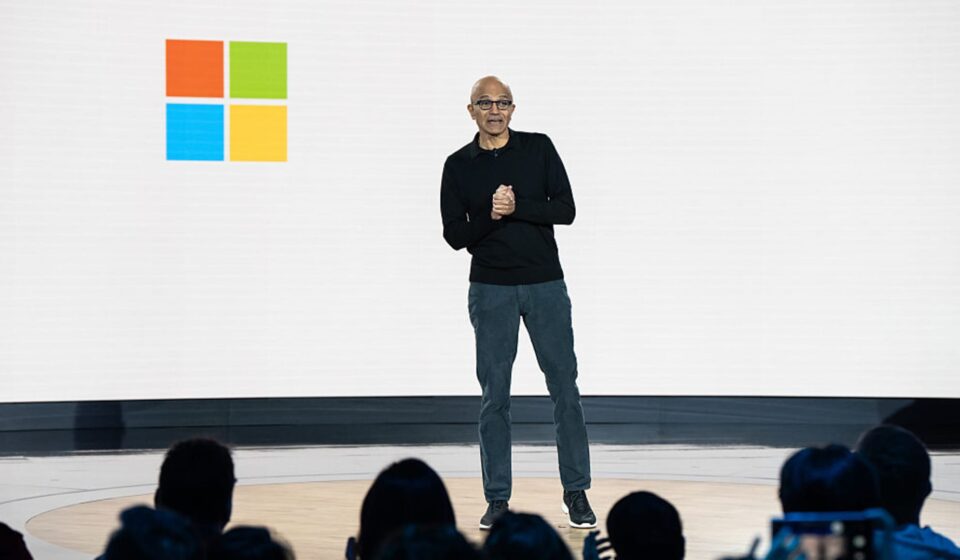
Wall Street rewards Microsoft’s AI pivot. A longtime skeptic flips bullish

When a longtime holdout on a stock changes his tune, it’s a really big deal. That’s why Wall Street is abuzz over Monday’s Microsoft note from closely watched analyst Ben Reitzes of Melius Research. Reitzes took the Club stock to a buy from hold, where his rating had been since a February downgrade. And even before that, he had been sounding the alarm that enterprise software stocks were vulnerable to AI disruption risks. Along with Monday’s upgrade, Reitzes also said that «at the risk of embarrassment,» he raised his price target all the way up to $665 from $465, implying more than 25% of upside to current levels around $525. Summed up in the title of his note, «The adults are in charge,» the analyst thinks that Microsoft’s experienced leadership and steady hand will be rewarded by clients and investors in this next leg of artificial intelligence. In Reitzes’ view, the recent freakout by Anthropic CEO Dario Amodei about AI safety, and follow-up from other key opinion leaders in the AI industry, served to strengthen the demand for Microsoft and the cyber companies needed to protect against the most severe concerns relating to data privacy and rogue AI agents. These more mature players will play «a key cog in the security, governance and the ‘AI CYA’ play that is likely in the early innings,» Reitzes wrote. Notably, Reitzes said he had felt this same way about Microsoft last year, before getting frustrated and more bearish due to issues with Azure and Copilot. Jim had also been frustrated with Microsoft. But as Jim always says, when the facts change, so should your opinion. His views did. And so have those of Reitzes, who said he is now ready to get more bullish on Microsoft, citing last month’s «repackaging of Copilot with Autopilot for agents may indeed be the product enterprises choose to corral potential chaos.» «Microsoft’s prospects in core apps and Azure are better than we previously thought, as it may be more insulated from agentic threats,» wrote Reitzes, who in 2024 predicted that AI will «eat a lot of software,» over the long term , a prescient call given the rise of the «SaaSpocalypse» narrative that took hold last year and reached a fever pitch earlier in 2026. We think Reitzes’ new argument is sound and aligns with Jim’s views that Microsoft’s Copilot pivot to enterprise makes it a safe space for companies to take advantage of AI for their businesses inside the protective embrace of the software platforms in which they are already heavily embedded. Put another way, fear of AI — be it an outside hack or the risk that an AI tool goes rogue — will solidify demand for those, like Microsoft, that can best protect against the risks. Enterprise customers appear more willing to bear the additional costs because it’s better to be safe than sorry. Reitzes believes more companies will ultimately turn to Microsoft on the idea that the newer labs are too erratic to plan an entire business implementation around. «We see a credible path for Azure growth to exceed 50% as supply begins to catch up with demand, pricing gets firmer, and OpenAI ramps.» Remember, Microsoft is still a main provider of computing power to OpenAI, even as the relationship between the two companies has evolved since the early days when ChatGPT launched in late 2022 and took the world by storm. That evolution has given Microsoft the freedom to become more model-agnostic. Microsoft has become less focused on the AI model layer and more on the harness layer. We previously discussed the importance of the harness in the context of agentic AI — the model being the brain and the harness as the body that can carry out the actions of the brain and act autonomously without further prompts. «The strategy seems even smarter now given its ‘partners’ are predicting the end of the world — and Microsoft, in essence, can provide Boards with a form of ‘AI insurance,'» Reitzes said. «Copilot is the front end; Agent 365 provides the registry, security and management layer for agents regardless of the underlying model. … The thought process is that as models become increasingly interchangeable, Microsoft can still capture value by owning the identity, governance, data and billing infrastructure around the agentic workflow. In this framework, the model is increasingly a commodity input while the enterprise harness becomes the strategic control point.» This gets to the heart of the matter. A frontier model alone is not enough to justify the massive levels of capital expenditures from these megacap tech companies. It’s more about what the companies can do with these models that matters to investors. Meta Platforms shares certainly tell that story. The stock has soared more than 20% since the company launched its Muse personal AI agent in early September and then doubled down on a new enterprise endeavor, including Muse for small businesses. It was the «how the model can be used» idea that really moved the needle, even as the strong benchmark results for the Spark model underlying it were well publicized. Bottom line Given that Microsoft is now looking to plant its own major flag at the application layer, but in the enterprise world in which it already dominates, Reitzes’ more optimistic outlook makes perfect sense. With shares now trading only about 3% away from their record-high close of $542 on Oct. 28, 2025, we think this sets the stock up to make a run back to those levels before breaking out further. We have a $550 per share price target on Microsoft. We, however, have a hold equivalent 2 rating because it’s not our style to chase parabolic moves. The stock has surged 50% since its 52-week low of $349 in late June. Microsoft’s strong quarterly results in July validated our patience with the stock and our trust in the management team of CEO Satya Nadella and CFO Amy Hood. Like Reitzes, we believe there will still be more payoff to be had. (Jim Cramer’s Charitable Trust is long MSFT, META. See here for a full list of the stocks.) As a subscriber to the CNBC Investing Club with Jim Cramer, you will receive a trade alert before Jim makes a trade. Jim waits 45 minutes after sending a trade alert before buying or selling a stock in his charitable trust’s portfolio. If Jim has talked about a stock on CNBC TV, he waits 72 hours after issuing the trade alert before executing the trade. THE ABOVE INVESTING CLUB INFORMATION IS SUBJECT TO OUR TERMS AND CONDITIONS AND PRIVACY POLICY , TOGETHER WITH OUR DISCLAIMER . NO FIDUCIARY OBLIGATION OR DUTY EXISTS, OR IS CREATED, BY VIRTUE OF YOUR RECEIPT OF ANY INFORMATION PROVIDED IN CONNECTION WITH THE INVESTING CLUB. NO SPECIFIC OUTCOME OR PROFIT IS GUARANTEED.
Fuente:
Leer la noticia original