
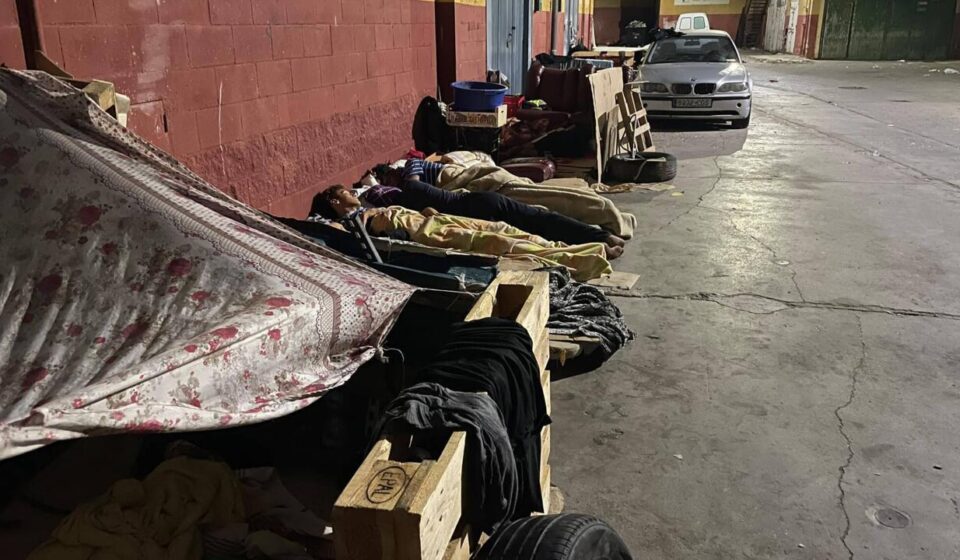

It’s 2am local time and a heavy silence hangs over the Tarajal industrial zone in Ceuta. The darkness is pierced by the flashing lights of police cars while waves crash against the shores of this Spanish enclave in North Africa, where many have attempted to cross into Europe but failed.
Not far from the beach, Moroccan minors sleep as they await a new day, not knowing what it will bring.
The open metal gates of the industrial zone give way to a space that, from the outside, looks like an auto repair shop. Hundreds of migrants gather here, including many minors left to fend for themselves. Some sleep on mattresses, others lie directly on the floor, and there are only a few blankets – which they take turns sharing – to protect them from the cold of the night or the heat of the day.
‘In search of a better future’
The figures reveal the scale of the crisis. The Spanish government estimates that around 2,500 minors remain on the streets of Ceuta following the wave of mass arrivals on July 30-31, when more than 70,000 migrants crossed the border from Morocco. The vast majority voluntarily chose to return home in the following days. But among those who remain in Ceuta, nearly 4,000 are minors, according to local NGOs. International NGO Save the Children estimates that only about 1,500 of them are currently being cared for by child protection services.
Read moreCeuta appeals for aid as child migrant crisis becomes ‘unsustainable’
Reda, 17, says he came to Ceuta in search of a brighter future. He was supposed to sit for his high school graduation exams this year and had just earned a diploma in French. He was also scheduled to try out for a football team.
But the precarious circumstances in which he lived drove him to leave. “We are here in search of a better future,” he says.
Returning to Morocco is not an option, he insists. “We won’t go back; we have no desire to go back,” Reda says, despite his difficult living conditions. He notes that the kids here on the streets of Ceuta remain hopeful that Europe will not abandon them.

‘My friend was killed right before my eyes’
After a perilous sea crossing to get to Ceuta, reaching dry land did not mean safety for many of these young migrants.
Khaled recounts how he and his friends were attacked by a group of youths from El Principe, a working-class neighbourhood in the southern part of the enclave. Their assailants brandished guns and tried to rob them, he says, and several of his companions were wounded and taken to hospital.
Reda says another friend was killed during an attack in the same neighbourhood. The two of them tried to flee, but his friend had leg injuries and was not quick enough to escape their attackers. He was then fatally wounded in the neck.
“My friend was killed right before my eyes; I will never forget that scene for the rest of my life. His dream vanished in an instant. Instead of starting a new life, he left this world,” Reda says.

Manal’s ‘nightmare’
A few steps away from Reda and Khaled, Manal, a 16-year-old Moroccan girl, tells another story of loss and fear. She explains that she left the northern Moroccan city of Tangier for Tetouan on foot, along with a group of migrants from sub-Saharan Africa, before entering Ceuta during the latest wave of crossings.
They then encountered a group of armed youths, she says. “We hid in the sewers, and they shot at us. If I hadn’t hidden, I’d be dead by now,” she says. The nightmare of that incident still haunts her.
Life has not been easy for Manal, who says her father never acknowledged paternity of her and that she lived with her grandmother before leaving for Ceuta. “I feel like life has closed its doors on me. I have neither ambition nor a future,” she says.

But Manal does have a modest dream: to improve her financial situation and lift her mother out of poverty.
Shortly after she arrived in Ceuta, Manal says the police transferred her to a centre for migrant minors. But she explains that the violence at the centre drove her to leave, and she now prefers to spend the nights outdoors.
Vulnerable minors
During our interview with Manal, a young man emerges from a reed tent set up nearby. It’s clear that our conversation has woken Mohammed, who is also 16 years old. He sighs and describes yet another difficulty for the migrants living in the Tarajal warehouses.
“We don’t have any toilets,” explains the young man from Larache, a city in northwestern Morocco. “So we’re forced to relieve ourselves near the sea. And even to wash ourselves, we have to use seawater.”
The kids rely on food provided by the Ceuta-based NGO Luna Blanca. But the meals are only distributed once a day.
Read moreIn Ceuta, migrants stranded at Europe’s gates await their fate
Many children still bear the marks of injuries sustained during their crossing to Ceuta almost three weeks ago. Poor hygiene and lack of access to medication have caused some wounds to fester and get infected. Many migrants are also suffering from scabies, and desperately seek medication to relieve the itching and pain.
Two minors collapsed in the industrial zone in the afternoon of August 12. One of them, weakened by a lack of food and water, could not withstand the intense August heat. The second boy was suffering from tonsillitis that had worsened due to a lack of treatment, leaving him unable to swallow. As the two boys lay on the ground, other migrants rushed to the scene, shouting for help and demanding an ambulance, which was slow to arrive.
Raul Arnaiz, programme director for Save the Children in Spain, describes the situation in the Tarajal warehouses as “a tragedy of extreme poverty”.
These unaccompanied minors are at risk of sexual assault and exploitation, given the lack of nighttime surveillance in a virtually deserted industrial zone, he warns.
Uncertain fate
In the early hours of dawn, a new journey begins. At 5am, hundreds of minors gather in front of the Ceuta police station, hoping to register themselves and enter the protection system. But the lines are long as Spanish authorities try to cope with the sheer volume of requests. Around 1,400 minors have been registered so far, according to Spanish Minister for Territorial Policy Angel Victor Torres.
Moroccan and Spanish authorities want to prioritise family reunification and repatriate the minors back to Morocco. But it’s not a simple procedure. Spanish law prohibits any collective repatriation of unaccompanied minors, and each case must be assessed individually.
Since minors are not subject to the same procedures as adults, they cannot be repatriated automatically, explains Basem Salem, an immigration lawyer specialising in asylum cases. The identity of the minors must first be established, their situation examined, and their family circumstances verified – all while respecting legal safeguards and the best interests of the child.
Read moreCeuta migrant influx reignites immigration divisions in Europe
Moroccan Justice Minister Abdellatif Wahbi says helping these children is a priority and that Rabat, through its consulates, has helped facilitate the process.
Spain’s Ministry of Youth and Children is set to hold a conference in late August to examine how to distribute resources and responsibilities between the central government and local authorities in Ceuta. Madrid has already allocated €25 million to help Ceuta cope with the crisis.
Torn between the hope of being transferred to reception centres in Spain and the fear of being sent back to Morocco, these young migrants remain in limbo, waiting to learn their fate. Meanwhile, the humanitarian crisis continues.
As night falls and the bustle of the day subsides, these minors return to the warehouses, the streets, the mountains, or the beach to try to get some sleep. Between the shores of two continents, separated by a few metres, these minors now find themselves caught between a dream they do not want to give up, a reality they cannot escape, and a future they cannot yet imagine.
This is a translation of an original article in Arabic.
Fuente:
Leer la noticia original