
It’s been almost two years since the world’s richest man Elon Musk threatened his political rivals with all-out war over skilled worker visas, but the fighting still drags on.
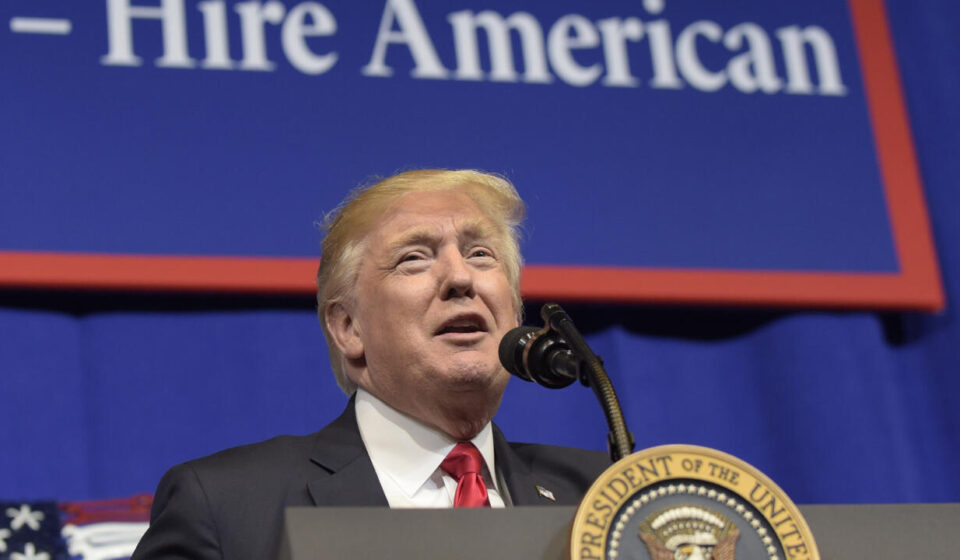
US President Donald Trump’s administration this week published a proposed regulation that would force employers to pay a one-off fee of more than $100,000 for any new H-1B temporary skilled work visa application – regardless, it seems, of whether the application is ultimately successful. The payment would come on top of existing fees, which range from around $2,000 to $5,000.
It’s not the first time the president has gone after the widely used guest worker programme. Last September, Trump issued a presidential proclamation slapping a temporary $100,000 fee on H-1B visa applications – a move that was suspended in June after a federal judge ruled the payment amounted to an unlawful tax.
Trump’s latest effort goes even further. While the president’s order last year only applied to people submitting visa applications from overseas, the latest proposal would seemingly stretch to foreign nationals already living in the US on student visas, who make up a growing share of H-1B visa recipients.
Read moreTrump’s $100,000 fee for H-1B visas, a tech industry favourite, concerns India
It could be months before the regulation takes effect. The Department of Human Services published the proposed rule in the Federal Registry on Tuesday, opening up a 30-day period for members of the public – and employers, and industry groups – to submit their feedback.
Much of that feedback promises to be harsh. The US tech industry is the leading employer of H-1B workers, and billionaire tech magnates including Musk have been vocal supporters of a scheme that they say helps draw the world’s best and brightest minds to Silicon Valley.
But critics of the programme on the left as well as the right have for years accused employers of using H-1B visas not to make up for a shortage in skilled graduates, but to fill low-level jobs with underpaid foreign workers who are wholly reliant on their employers’ good graces for their ability to live and work in the US.
‘Hugely abused’
The US government issues some 85,000 H-1B visas every year, 20,000 of which are reserved for applicants with advanced degrees from US institutions – a figure dwarfed by the number of applications registered by employers, which last year sat at more than 344,000. Every April, the government holds a lottery to determine which applications make the cut.
More than half of all H-1B workers work in computer-related jobs – technical support, programming, systems analysis and the like. Roughly three quarters of H-1B workers are born in India, with Chinese-born workers following far behind at just over one in ten.

Proponents of reform point to the growing role of often India-based IT staffing and outsourcing firms in filing H-1B visa applications. Under this model, they argue, US companies can comfortably outsource their hiring of guest workers to third-party firms, allowing them to avoid legal stipulations that they pay visa-holders the same rates they would pay their own employees.
In the fact sheet accompanying the proposed regulation, the US government pointed to several major US companies – their names discreetly withheld – who had continued to be approved for thousands of guest worker visa applications even as they laid off thousands of workers.
In 2025, a software engineer filed a class action lawsuit against Musk’s Tesla alleging the company hired an estimated 1,355 H-1B visa-holders while laying off more than 6,000 workers across the US.
Read moreHow visas for skilled foreign workers are splitting MAGA in two
Hal Salzman, a professor of planning and public policy at the Edward J. Bloustein School and senior faculty fellow at the John J. Heldrich Center for Workforce Development, said that the idea that the majority of H-1B visa holders were making up for chronic domestic skill shortages didn’t stand up to scrutiny.
“It’s been hugely abused,” he said. “And you have to ask yourself, how is the IT industry the only industry that’s been claiming a [skilled labour] shortage for over 25 years – and can’t seem to fill it? These are jobs that require skill, and some talent, but it’s not like they’re PhD-level markets, where we have an oversupply. So we can oversupply PhD markets, but we can’t fill tech jobs – most of which are not at Google, really rare positions, but common IT support and back-office jobs.”
‘Indentured servitude’
Despite advocates arguing that the H-1B programme is first and foremost about filling labour shortages, companies filing visa applications are not required to show that they’ve tried to fill the position with US-born workers first.
While online discussions about H-1B visas among Trump supporters often take a luridly nativist turn, the programme in its current form has staunch opponents in the ranks of the Democrats and the Republicans alike.
Senator and democratic socialist Bernie Sanders last year slammed the programme as a form of “indentured servitude” that exploited precarious visa-holders even as it drove US-born workers out of the job. Senators Chuck Grassley and Dick Durbin, a Republican and a Democrat, have for years pushed for bipartisan legislation to raise guest worker wages as well as require employers hoping to hire H-1B guest workers to post the job listings on a Department of Labor site.
Ron Hira, an associate professor at Howard University’s department of political science who has been a vocal advocate of H-1B visa reform, maintained that the programme as it currently stood was unfair not just for US-born workers, but for the guest workers as well.
“The fundamental problem with the H-1B programme, with any guest worker programme, is it’s labour policy, it’s not immigration policy – what you’re trying to do is set the rules around the labour market,” he said. “Because guest workers like H-1Bs don’t have the same rights as a citizen or a permanent resident in terms of employment rules and laws.”
Hira said that guest workers’ utter dependence on their employer made it difficult for visa-holders to advocate for better pay or working conditions, or to push back on workplace abuses when they happened. H-1B visas last between three and six years, and any pathway to permanent residency depends on their employers sponsoring their applications.
“In the case of the H-1B, the employer holds the visa, holds their legal status, and if they lay that worker off, that worker has to leave the country within 60 days,” he said.
“So if you’re a worker and you’ve been here for four years, and you want to stay permanently, and your employer says, ‘if you don’t stay until 10 o’clock at night, I’m gonna lay you off’, or threatens you – you’re going to be much more docile, right? You have a lot less bargaining power. So that puts them on an un-level playing field to begin with.”
Read moreTrump’s assault on federal worker union rights is just the beginning
Labour advocates have long called on the US government to revise its current wage structures for guest workers, which critics say make it possible for employers to legally pay H-1B holders far less than US-born workers with the same qualifications doing the same job.
George Borjas, who sat on the Council of Economic Advisers as a senior economist during the first year of Trump’s second term in office, published a research paper earlier this year that argued H-1B holders were paid an average of 16 percent less than comparable US-born workers. For software developers and computer programmers, he wrote, that wage gap rose to 30 percent. Other economists have disputed his findings.
While Trump’s proposed fee is designed to raise the cost for employers in hiring H-1B workers, another proposed regulation put forward by the Department of Labor in March appears to tackle the problem from the other end.
The proposal would, among other things, raise the current wage floor for H-1B workers, doubling the minimum bracket from the 17th prevailing wage percentile to the 34th – still well under the median wage for US-born workers in the same job.
“These wage levels that are set, they don’t reflect what is the actual market wage – meaning what employers are paying in markets for the given level of talents,” Salzman said. “So they’ve been able to under-classify, allowing them to legally underpay H-1B workers. This is an attempt to have them more properly classified at accurate wage levels.”
Hira said that while Trump’s proposed fee was not something that he had personally advocated, he saw the logic of it.
“What raising the fee does is instead of raising the wages of the H-1B workers, what it goes at is the profitability that the employers see in the worker,” he said. “So, instead of attacking that wage gap, what it does is it attacks where the employers are getting surplus value from those workers. What it’ll do is it’ll force the employers to be more discriminating, to be more selective about the kinds of H-1B workers that they apply for.”
Despite the hefty levy, he said, some employers with deep pockets would be undeterred by the six-figure price tag.
“The $100,000 fee sounds like a lot, but if you put it in the context of a six-year H-1B … that’s about $16, $17,000 a year – and given the wage scales in America, sixteen thousand dollars a year is not a huge amount,” he said.
“So what it’ll do is it forces employers to say, ‘hey, if I can make $30,000 a year off of this worker, then it’s worth me paying that $16,000 a year to go ahead and do that’. The ones where the employers aren’t making that much money, they will decide not to apply for H-1Bs – because economically, it doesn’t make sense.”
Fuente:
Leer la noticia original